
The National Research Facility for Phenotypic and Genetic Analysis of Model Animals (MAF) was established under the “12th Five-Year” National Major Scientific and Technological Infrastructure Projects of China. The Kunming Institute of Zoology (KIZ), Chinese Academy of Sciences (CAS), in Kunming and the China Agricultural University in Beijing are the lead legal entities involved in the construction and support of research facilities for non-human primates (NHPs) (Primate Facility, Kunming, Yunnan) and porcine animals (Pig Facility, Zhuozhou, Hebei), respectively.
Since its launch in October 2019,KIZ has overseen the facility’s development,ensuring both the timely completion and high standards of construction. All infrastructure components,including equipment installation and internal and external designs,have been finalized. The Primate Facility underwent five separate inspections between 2023 and 2024,marking the transition to the pilot operational phase.
Designed as a world-class, large-scale integrated research platform, the Primate Facility enables comprehensive investigations into NHPs phenotypic and genetic characteristics across the entire lifespan. By integrating phenotypic assessments with genetic analyses, the facility advances understanding of phenotype-genotype interactions, biological regulation, and adaptive responses to environmental changes, and provides a critical platform for translational research addressing key challenges in disease mechanisms and therapeutic development. The facility comprises four core systems: the Model Animal Production and Breeding System, Phenotype Analysis System, Genetic Analysis System, and Information Processing and Intelligent Automated Management and Control System. It has the capacity to house and conduct research on 5500 primates, supporting standardized husbandry, large-scale experimental studies, precision phenotypic measurements, and advanced computational analyses. It has achieved internationally recognized advancements in NHPs resource conservation, genomic profiling, genetically modified animal modeling, phenotypic measurement technologies, and high-resolution quantification methodologies. As a critical national research infrastructure, the Primate Facility enhances global competitiveness in deciphering the molecular and physiological mechanisms of key phenotypes, including disease pathogenesis, brain function, and neurological disorders. It also plays a central role in studying major infectious diseases and pioneering novel therapeutic strategies.
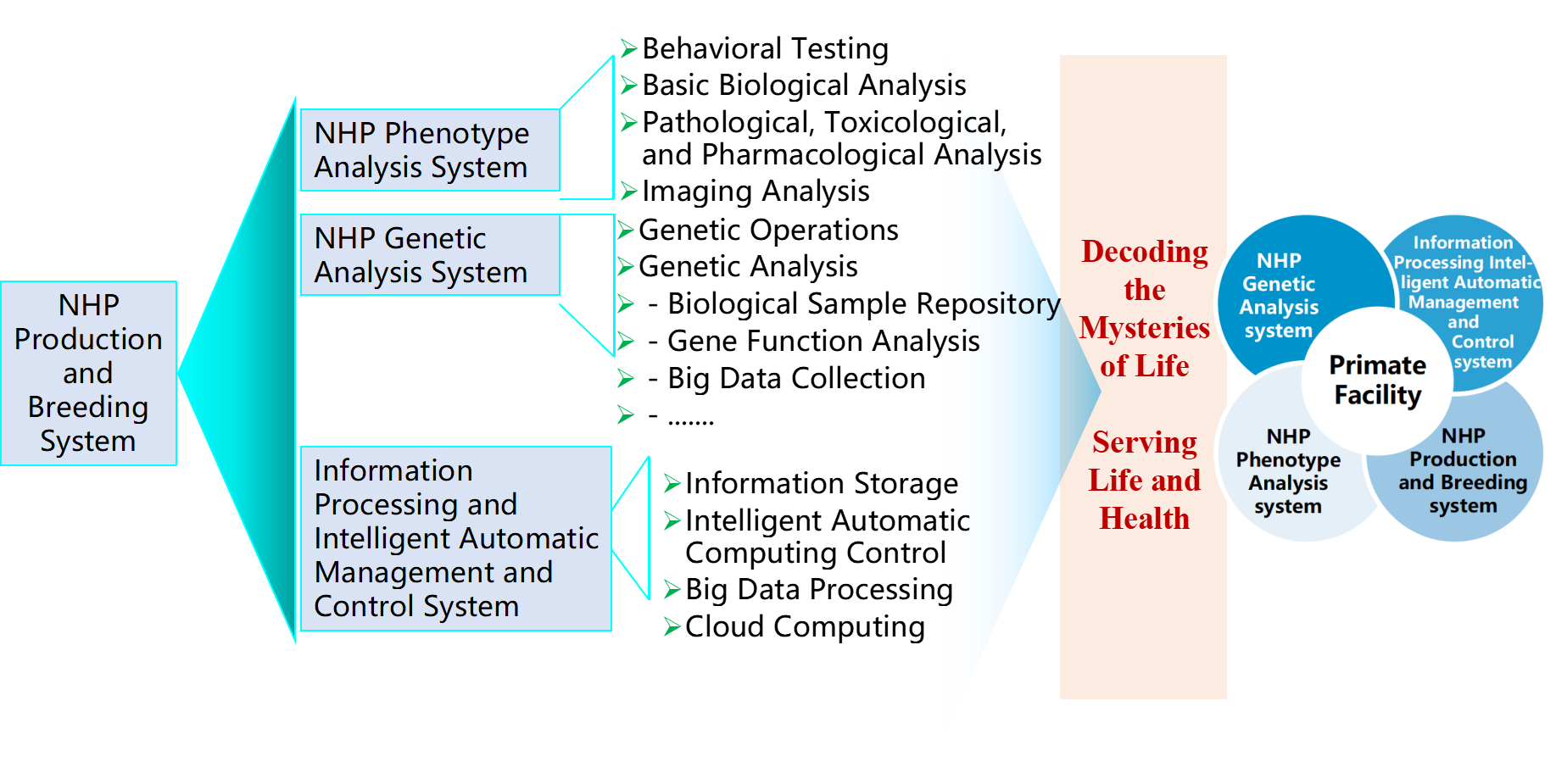
Primate Facility Construction