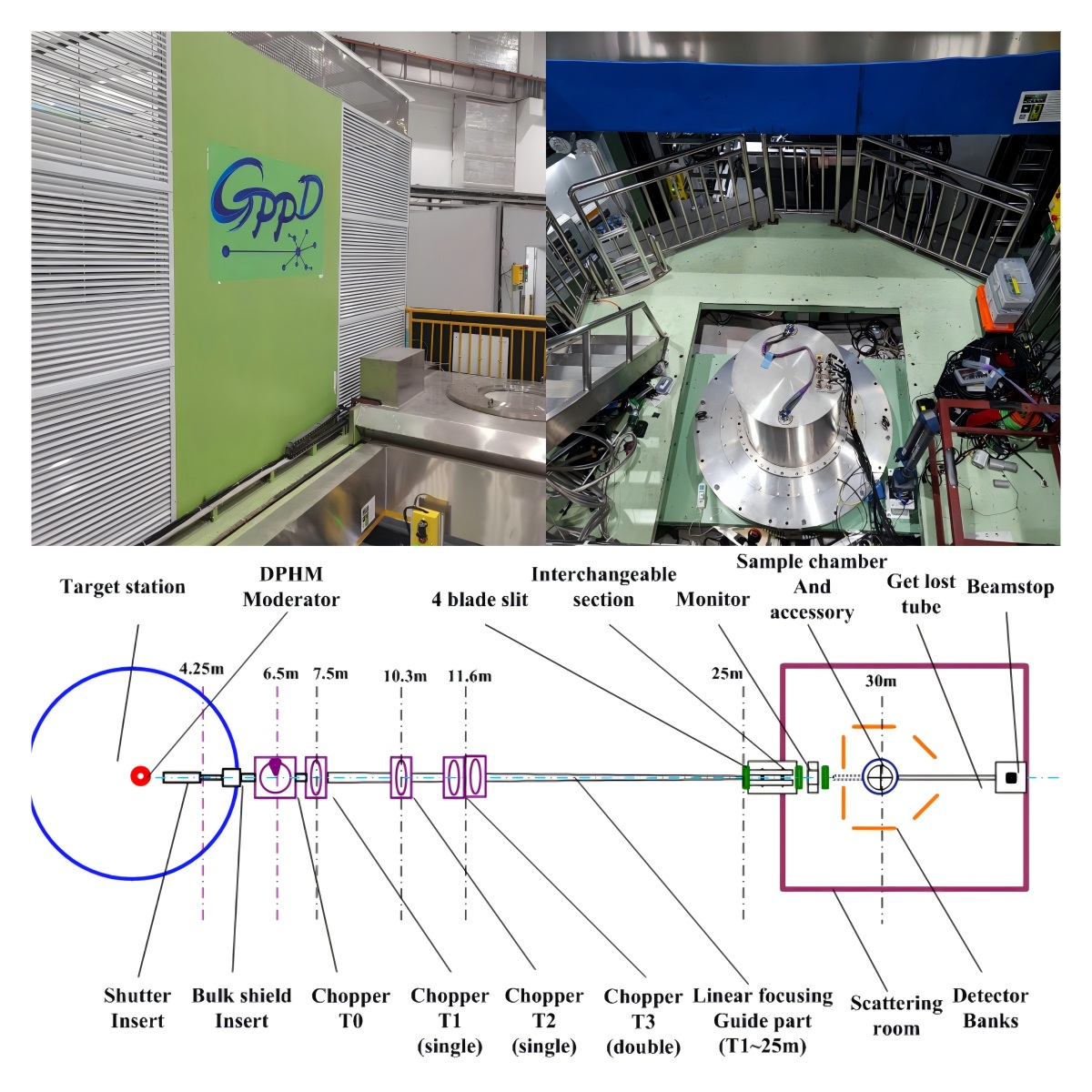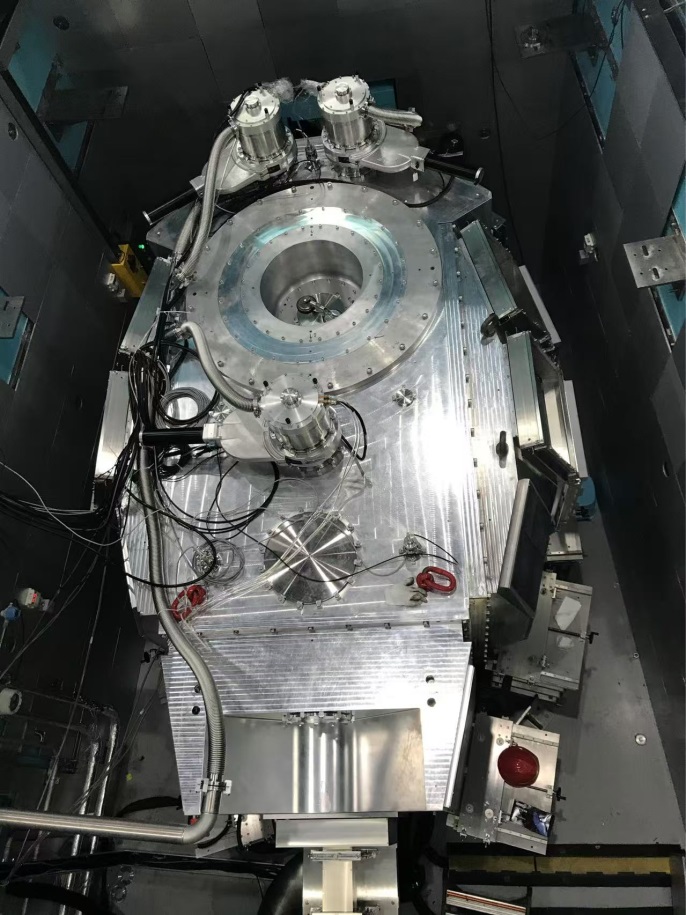
General purpose powder diffractometer (GPPD) is an elastic scattering spectrometer, which is mainly used to study the crystal structure and magnetic structure of substances. It provides a powerful detection method for basic research in materials science, chemistry, physics, engineering, resources and environment, and other fields, and offers significant technical support for the development of high-tech industries such as new energy, electronic information, and instrumentation equipment. After stress modification, the GPPD now combines both powder diffraction and residual stress measurement conditions. The GPPD features high resolution, a wide range of d-space detection, and excellent signal-to-noise ratio. Utilizing neutron time-of-flight technology, the distance from the moderator to the sample is 30 meters, the neutron bandwidth is 4.8 Å, and the d-space detection range reaches 0.05 - 50.48 Å. The GPPD is equipped with three sets of detectors at different angles, allowing for simultaneous backscattering, medium-angle, and small-angle neutron diffraction experiments: the high-angle backscattering detector (150˚) is suitable for high-resolution studies, with a resolution that can reach 0.15%; the medium-angle detector (90˚) effectively avoids scattering from the sample chamber, making it suitable for structural studies under special sample environments and stress distribution studies; the low-angle detector (30˚) has a wide coverage of d-space, making it suitable for determining structures with large unit lattice cells/magnetic cells. The GPPD's outstanding peak profile and signal-to-noise ratio can be used for the measurement and analysis of crystal and magnetic structures of samples with masses as low as a few hundred milligrams, thus meeting the high-precision characterization needs of most advanced materials' fine structures.
(Introduction of GPPD: https://doi.org/10.1016/j.nima.2023.168414, https://doi.org/10.1016/j.nima.2023.168532.)