
Recently, a research team led by Prof. Fan Wei from the Joint Laboratory on High-Power Laser Physics at the Shanghai Institute of Optics and Fine Mechanics (SIOM), Chinese Academy of Sciences, in collaboration with Associate Researcher Wu Fuyuan from Shanghai Jiao Tong University and Prof. Wang Weimin from Renmin University of China, has achieved new progress in enhancing the spatiotemporal modulation capability of nanosecond lasers for the Double-Cone Ignition (DCI) scheme. The related findings were published in Optics Express under the title "Spatial-temporal modulation method of nanosecond laser for the double-cone ignition scheme."
The DCI scheme integrates the advantages of direct drive and fast ignition approaches, comprising four independently controllable processes: near-isentropic compression, hybrid acceleration, collisional preheating, and fast-electron-ignited burn. Nanosecond laser pulses irradiate the interiors of two opposing gold cones. Through the ablative rocket effect, the laser compresses the spherical-cap target to form high-density plasma, which then collides with high-density fuel injected from the opposing cone, further increasing the plasma density. Subsequently, a picosecond laser generates fast electrons to heat the resulting high-density plasma to fusion ignition conditions, releasing substantial energy. For the DCI scheme, increasing the power density of the picosecond laser is challenging. In contrast, precise temporal control and power balance of the nanosecond laser are demonstrably more conducive to achieving near-isentropic compression, yielding higher areal density and thus enhancing fusion energy gain under comparable conditions. Therefore, maintaining energy and power balance throughout the compression phase, along with precise control of the time-power profile, is critical. Major facilities like NIF and OMEGA impose strict requirements on power balance during compression. At NIF, where four beams strike the same target surface, the focus is on power balance among each set of four beams. At OMEGA, where each beam strikes a different target surface, the emphasis is on beam-to-beam power balance. The DCI scheme, due to its unique structure, prioritizes energy balance across the two opposing conical surfaces.
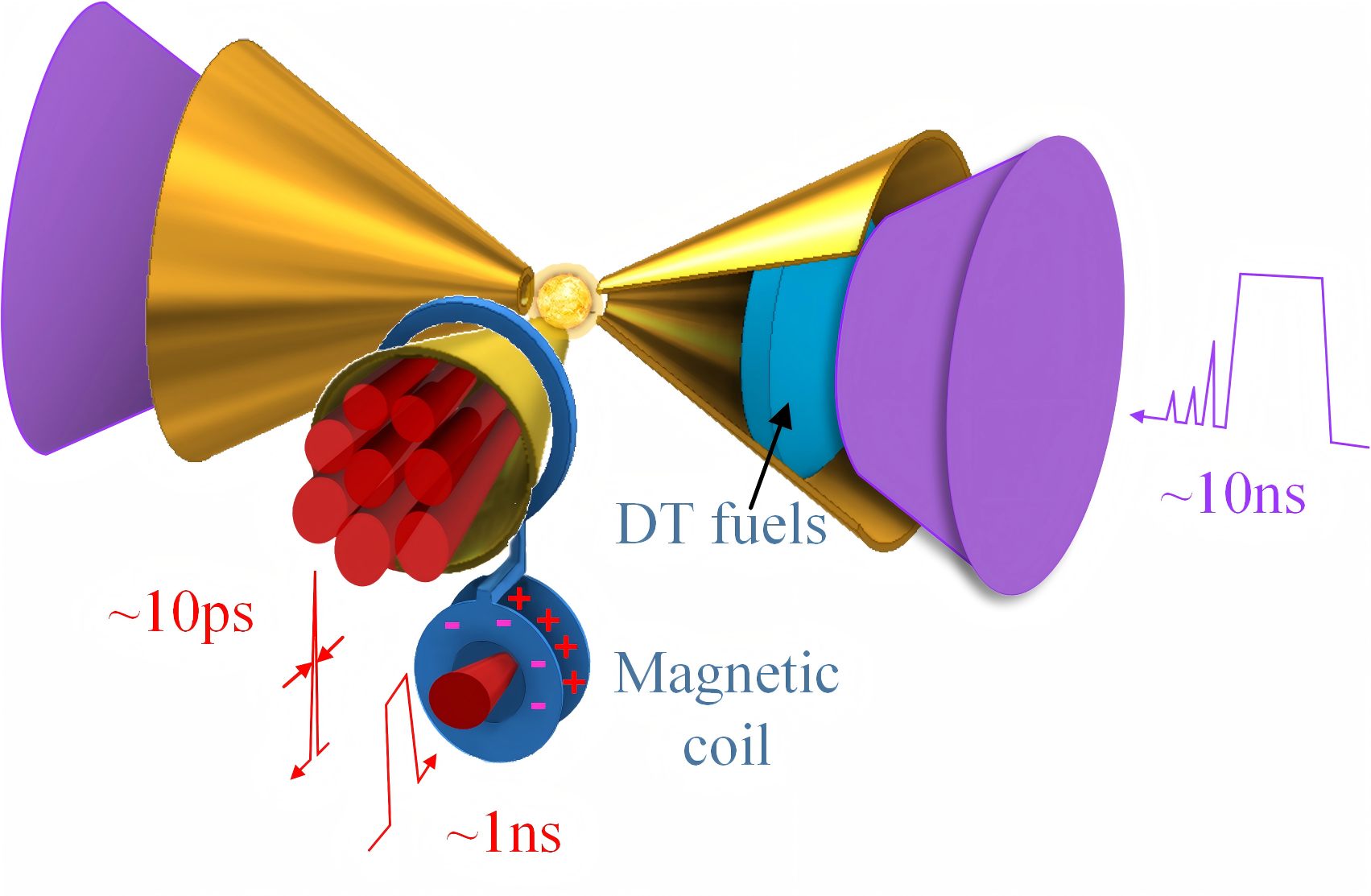
Figure 1: Schematic diagram of the double-cone ignition (DCI) scheme.
Laser pulse transmission is susceptible to various factors (including shaping unit instability, pump source fluctuations, etc.), leading to degraded pulse stability. However, gain saturation effects can enhance pulse stability. For high-contrast laser pulses, the high-power portion saturates the gain first, while the low-power portion remains largely linearly amplified. This hinders precise temporal control, particularly in the early stages of the drive laser. Addressing this, the researchers proposed a pulse segmentation model specifically for the DCI scheme. While satisfying the requirement for the near-isentropic nanosecond compression waveform driving the implosion, this model redistributes the time-power profiles among the individual beamlets within the facility to reduce the waveform contrast of each beamlet. A small number of beamlets generate a low-power foot pulse, focused onto the target surface at its initial radius to provide better illumination uniformity. The remaining beamlets generate the high-power main drive pulse, focused onto a relatively smaller target surface. This approach allows the foot pulse to also reach gain saturation while simultaneously mitigating the effects of Cross-Beam Energy Transfer (CBET). Simulation results indicate this pulse segmentation model enhances foot pulse stability. Considering the third-harmonic generation (THG) output, the redistributed pulses exhibit significantly improved stability during the shock compression phase and the entropy-tuning ramp phase – improving from 50% and 20% instability to 26% and 6.1%, respectively. This spatiotemporal modulation scheme is expected to enhance the facility's power balance control capability and enable dynamic focal spot control. It provides a valuable reference for improving the nanosecond laser spatiotemporal modulation capability for both the DCI scheme and ignition schemes driven by a very large number of beams.
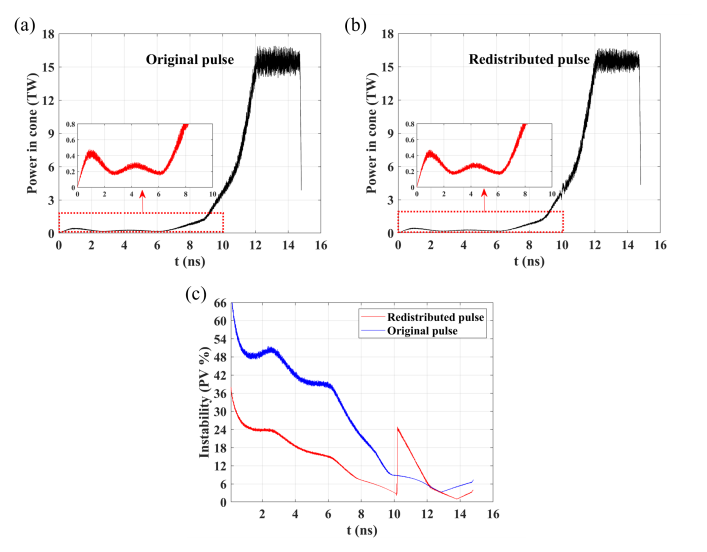
Figure 2: Time-power profiles: (a) Original pulse; (b) Redistributed pulse; (c) Pulse instability at different times.
This research received support from the CAS Strategic Priority Research Program.


