
Recently, the research teams from the ShanghaiTech University Great Science Center and the University College London Centre for Nanotechnology have collaborated to explore a novel femtosecond diffraction imaging method using the Shanghai Soft X-ray Free-Electron Laser Imaging Experimental Station. This achievement was published in March 2025 under the title "Single-shot X-ray imaging of two-dimensional strain fields in colloidal crystals" in the journal IUCrJ of the International Union of Crystallography (IUCr). Two-dimensional (2D) superlattices, with their tunable mechanical, electronic, and optical properties, can form ordered structures through the self-assembly of monodisperse colloidal particles, enabling precise design of composition and performance. They provide an ideal platform for studying phonon behavior and phase transition mechanisms. Among them, defects (such as dislocations and disclinations) play a crucial role in the formation of the hexagonal phase and the 2D melting process, and related theoretical achievements have promoted breakthrough developments in condensed matter physics. However, the dynamic evolution mechanism of defects and the quantitative regulation law of their effects on the macroscopic properties of materials remain unclear. How to achieve the directional construction and dynamic tracking of defects has become a core problem to be solved in this field.
Bragg coherent diffraction imaging (BCDI), as a non-destructive imaging technology with nanometer-scale sensitivity, can realize in-situ dynamic observation of lattice strain and defects. Combined with the ultra-high spatio-temporal resolution of hard X-ray free-electron lasers, this technology has made breakthrough progress in the study of picosecond-scale lattice dynamics of materials such as gold and barium titanate, successfully resolving the lattice evolution mechanism under ultrafast non-equilibrium states. In recent years, with the breakthrough of soft X-ray free-electron laser technology, the BCDI technology has further expanded the research dimension to the field of ultrafast dynamics of topological defects in 2D superlattices, providing a new observation means for the study of structural phase transitions in the nano-femtosecond dual scale. Based on the single-pulse BCDI technology,this study has realized the transient ultrafast high-resolution reconstruction of the 2D superlattice of gold particles for the first time,and the established experimental method has laid a key technical foundation for the follow-up pump-probe ultrafast dynamics research.
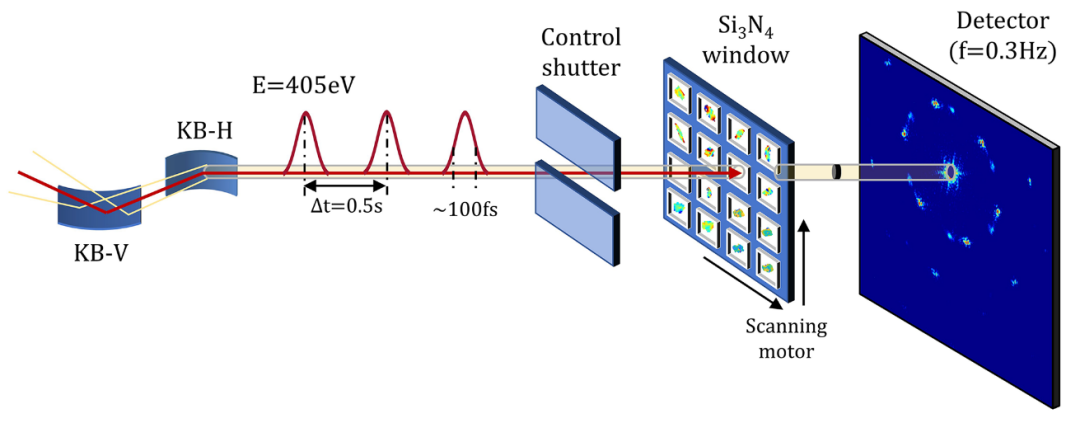
Based on the high-brightness coherent light source of the Shanghai Soft X-ray Free-Electron Laser Imaging Experimental Station,the research team prepared a highly ordered gold particle monolayer superlattice sample on the Si₃N₄ window and successfully collected the transient Bragg diffraction spots of the superlattice under a single pulse (Figure 1).
The research team successfully resolved the structure and stress distribution map of the two-dimensional (2D) gold particle superlattice based on iterative phase retrieval algorithms and 2D reconstruction techniques. Through the recombination and calculation of multi-Q vector diffraction data, quantitative characterization of the full-component strain tensor of the 2D crystal was achieved (Figure 2). Experimental results show that the spatial resolution of the reconstructed image reaches 110 nanometers, and the lattice displacement sensitivity breaks through the 1-nanometer magnitude. This method provides an effective research tool for the dynamic analysis of defect evolution on ultrafast time scales.
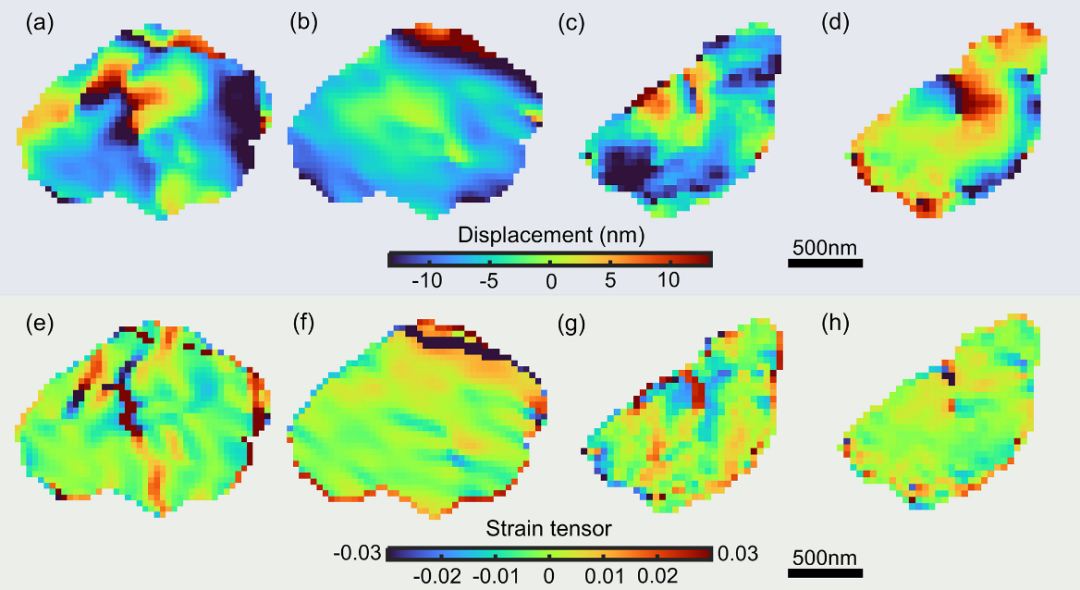
Figure 2: Atomic displacement maps (a-d) and strain tensor maps (e-h) of two crystals obtained after phase retrieval of single-pulse diffraction spots.
Jiecheng Diao,Assistant Researcher at ShanghaiTech University,and Zichen Gao,Postdoctoral Fellow at ShanghaiTech University,are the co-first authors. Professor Huaidong Jiang and Researcher Jiadong Fan from the Great Science Center of ShanghaiTech University,and Professor Ian Robinson from University College London,are the co-corresponding authors.

