Members of the Meridian Project team, led by Professor Xue Xianghui from the University of Science and Technology of China, have conducted observational and predictive research on atmospheric metal atomic layers and ionospheric sporadic E layers (i.e., atmospheric metal ion components) using data from multiple ground-based sodium lidar stations, ionospheric digital altimeters, satellite data, and global models. The research includes:
1. For the first time, a comprehensive study was conducted on the global distribution and modeling of sodium atomic layers using multiple sodium lidar observation chains, satellite observations, and atmospheric models. By analyzing the global spatiotemporal distribution of sodium atom density and its variations with altitude, latitude, and season, the study compared the spatiotemporal patterns of metal layer atoms and ions, revealing the underlying physical mechanisms behind phenomena such as sporadic sodium layers.
2. An empirical model for global ionospheric sporadic E layers was established. The model outputs were calibrated and compared using observation data from the Beijing ionospheric digital altimeter, confirming the accuracy of the model results. This work was published in the European Geosciences Union journal Atmospheric Chemistry and Physics and the American Geophysical Union journal Space Weather, with Professor Xue Xianghui as the corresponding author and Dr. Yu Bingkun as the first author.
The paper received widespread attention from scholars worldwide after publication and was awarded the 2022 "Wiley China Open Science High Contribution Author" prize. This achievement was recognized as an outstanding result of the Meridian Project in 2022.
The upper-middle atmosphere, located above 30 kilometers from the ground, is extremely sparse and can experience significant changes due to disturbances such as tropospheric weather, solar radiation, and high-energy particle events from the solar wind, all of which directly affect spacecraft flight trajectories and lifespan. Research on the upper-middle atmosphere is crucial for ensuring the safety of space activities and communication and navigation systems.
The upper-middle atmosphere around 100 kilometers in altitude is a detection blind spot where satellites cannot reach from above and weather balloons cannot reach from below. Lidar technology is a primary method for probing the upper-middle atmosphere. By using resonance fluorescence lidar to detect metal atoms in this region, researchers can effectively trace and study the complex and variable processes occurring in the upper-middle atmosphere. The Meridian Project's stations in Beijing, Hefei, Wuhan, and Haikou have accumulated over a decade of sodium fluorescence lidar observation data, totaling thousands of hours. This data provides high spatiotemporal resolution observations of the sodium metal layer along the 120° east meridian at various latitudes (as shown in Figure 1).
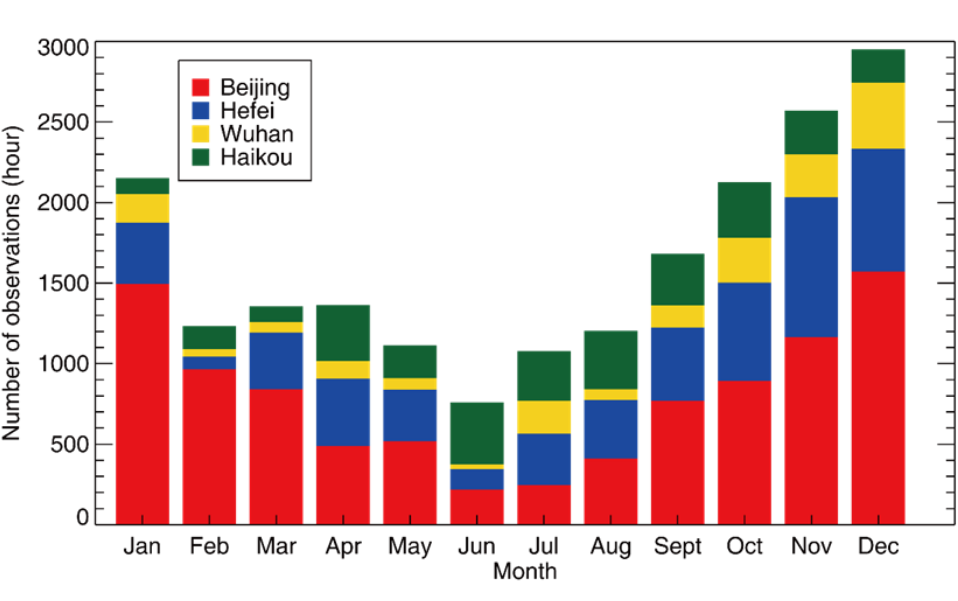
Figure 1: Observation Duration of Sodium Fluorescence Lidar in Beijing, Hefei, Wuhan, and Haikou by Month
The research leveraged the advantages of the Meridian Project's multi-station chain observations. By using data accumulated from sodium lidar observations at four stations, in combination with satellite hyperspectral remote sensing and atmospheric models, a detailed comparative study of ground-based, space-based observations, and model outputs of the middle atmospheric sodium layer was conducted (see Figures 2 and 3). The study also discussed the latitudinal asymmetry of the sodium layer and seasonal variations in sudden sodium layers, and their coupling with sporadic E layers (see Figure 4). By integrating data from multiple sodium lidar stations, satellite observations, and global models, the research examined the seasonal and latitudinal variations of the global sodium layer and compared these findings with model outputs. The results indicated a good consistency between sodium layer density observations from lidar, satellite observations, and atmospheric model results. However, the study also pointed out that existing atmospheric models, due to their horizontal resolution limitations, cannot resolve smaller-scale gravity waves. In some regions, there were significant discrepancies between model predictions and observations. These findings provide important references for improving atmospheric metal models.
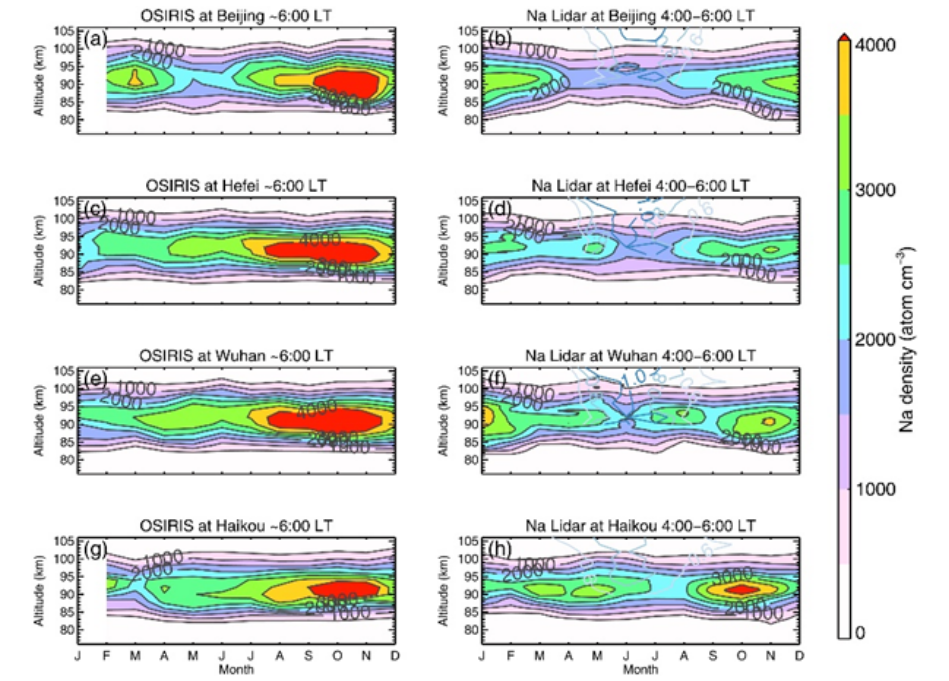
Figure 2: Seasonal Variation of Sodium Atom Density in the Metal Layer Observed by Satellite and Lidar
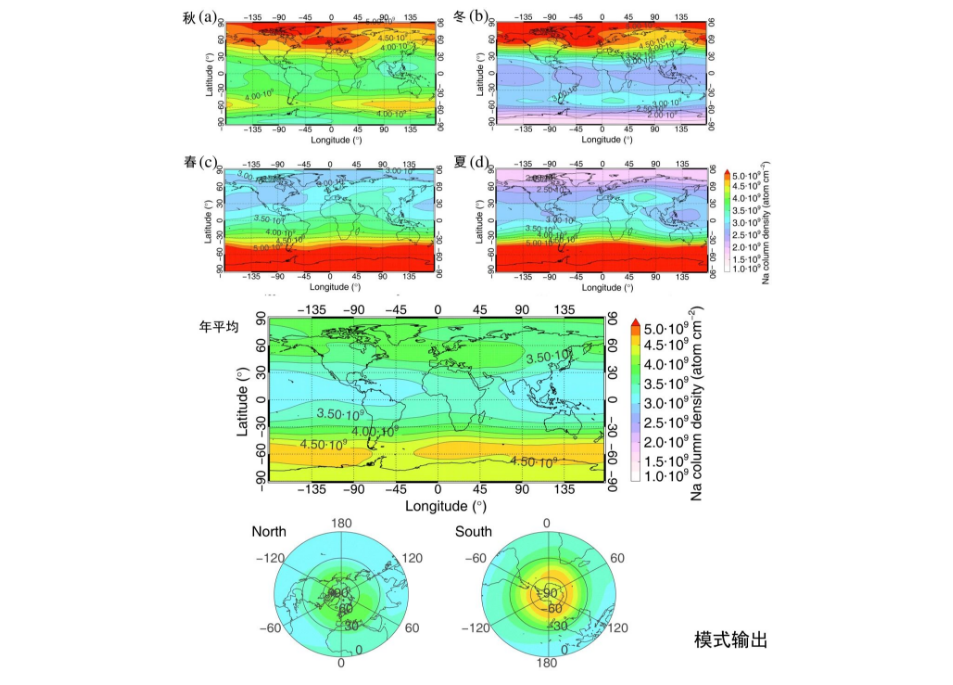
Figure 3: Global Distribution of Sodium Column Density from Satellite (Top) and Model (Bottom)
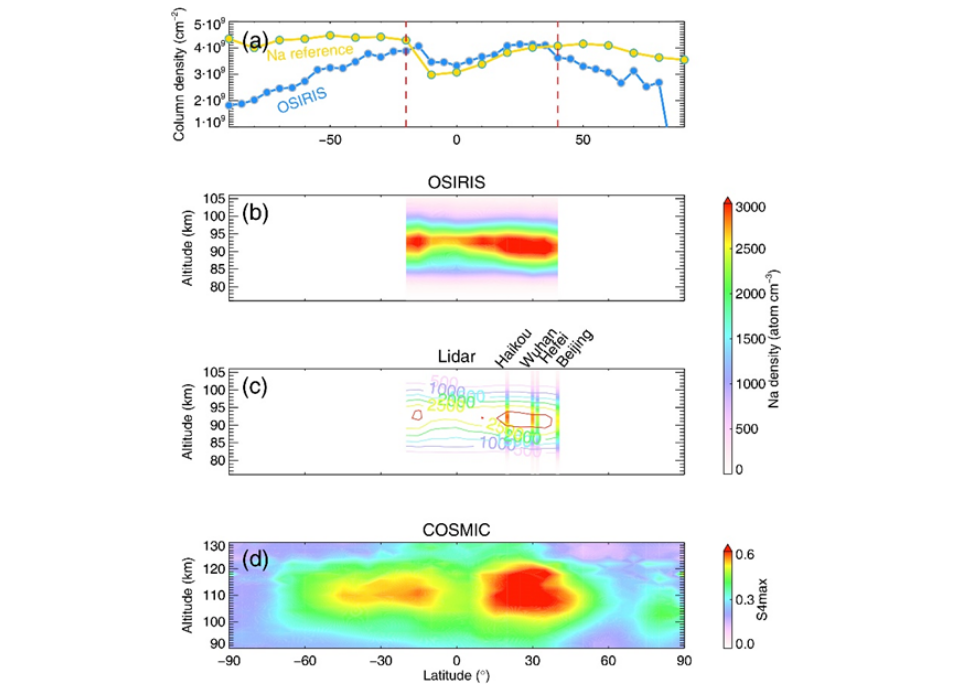
- (a) Latitude Distribution of Sodium Column Density Observed by Satellite and Reference Values Na reference (Plane, 2008)
- (b and c) Sodium Observations by Satellite and Lidar
- (d) Distribution of Sporadic E Layer Intensity with Latitude and Altitude
Due to the lack of effective global models for predicting the occurrence and intensity of sporadic E layers, the research team established an empirical model for sporadic E layers based on scintillation amplitude S4max data extracted from low-orbit satellite radio occultation observations (see Figure 5). The model was calibrated and compared with data from the Beijing ionospheric sounding instrument. The correlation between model predictions and the ionosonde critical frequency foEs observations is 0.52 (hourly) and 0.68 (daily). The model can effectively forecast the global distribution and variations of sporadic E layers, helping to clarify the spatial and temporal evolution and mechanisms of ionospheric E layer irregularities.
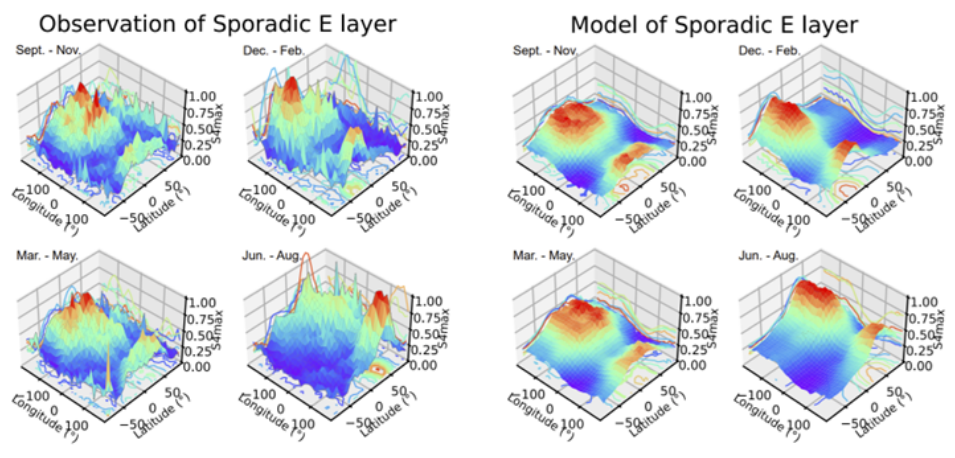 This study, based on comprehensive monitoring data from the Meridian Project's space environment, investigates the ground-based, space-based observations, and forecasting of neutral and ionized components of the atmospheric metal layer. It provides significant insights into the global distribution and variations of the metal layer and enhances the understanding of middle and upper atmospheric and ionospheric dynamical processes and physical-chemical characteristics. Relevant papers titled "Comparison of Middle-and Low-Latitude Sodium Layer from a Ground-Based Lidar Network, the Odin Satellite, and WACCM-Na Model" and "An Empirical Model of the Ionospheric Sporadic E Layer Based on GNSS Radio Occultation Data" have been published in the authoritative atmospheric science and space physics journals, Atmospheric Chemistry and Physics and Space Weather.
Download Link for the Original Text
1. https://doi.org/10.5194/acp-22-11485-2022
2. https://doi.org/10.1029/2022SW003113