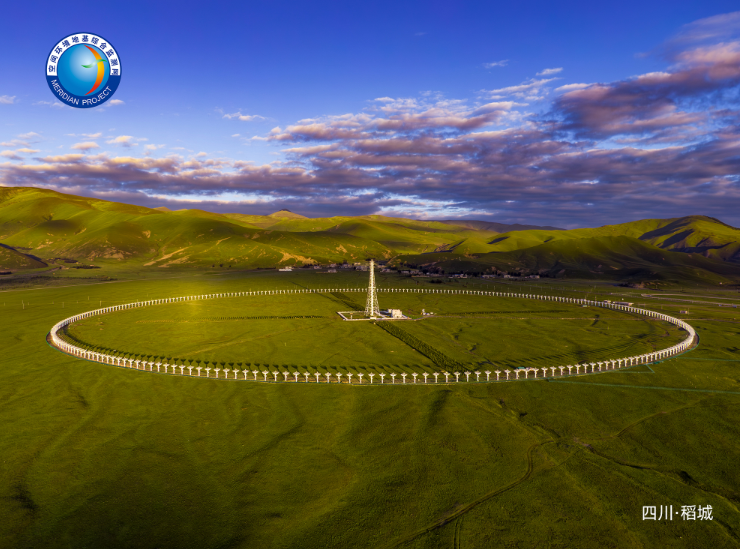
On March 21st, the National Development and Reform Commission approved the construction of the "13th Five Year Plan" National Major Science and Technology Infrastructure Space Environment Foundation Comprehensive Monitoring Network (Ziwu Project Phase II), which has officially passed national acceptance. This is the first comprehensive space environment ground-based monitoring facility covering the entire solar atmosphere, magnetosphere, ionosphere, and upper atmosphere in China, marking the country's leading position in the world in space environment ground-based monitoring capabilities and contributing Chinese solutions to global space weather research.
The solar terrestrial space is the main area for human space activities and the development and utilization of space. Catastrophic space weather can lead to significant risks such as satellite failure, communication interruption, navigation deviation, and power grid paralysis, posing a threat to national security and basic infrastructure for people's livelihoods. The completion of the second phase of the Ziwu Project has achieved multidimensional breakthroughs in coverage breadth, technical depth, and detection accuracy, which will significantly enhance China's space weather forecasting and early warning capabilities and provide strong support for seizing the strategic high ground of space science and technology.
The construction of the second phase of the Meridian Project was started in November 2019. Led by the National Space Science Center of the Chinese Academy of Sciences, 15 units from 8 departments worked together to tackle key problems, and innovatively built a monitoring system of "one chain, three networks, and four focuses" to achieve full chain tracking and monitoring from solar surface eruptions, interplanetary transmission to geospatial response. To achieve collaborative networked monitoring of near Earth space (geomagnetic, ionospheric, and upper atmosphere) in China's mainland and the polar regions of the Earth, thereby assisting in cutting-edge scientific research on the overall change mechanism of the solar terrestrial space environment, basic physical processes of space physics, and providing key independent data input for China's space weather forecasting and early warning services.
The second phase of the Ziwu Project has built a batch of large-scale monitoring equipment,whose technical indicators have reached the international advanced level,such as the world's largest comprehensive aperture radio telescope - the Circular Array Solar Radio Imaging Telescope,which has achieved continuous and stable solar radio imaging and spectral observation capabilities with a maximum field of view of 10 Rs (solar radius),as well as three-dimensional tomography of coronal radio activity;The world's first all season observation array type large aperture laser radar has achieved a detection altitude of 200-1000 kilometers,and its signal sensitivity is 100-200 times that of similar international equipment;The phased array incoherent scattering radar with the strongest global detection capability,capable of CT scanning and 3-compost imaging detection of thousands of kilometers of ionosphere;A mid latitude high-frequency radar that fills the monitoring gap in the international super dual aurora radar network,achieving continuous monitoring of the mid latitude ionospheric environment in the Asian sector with a depth of over 4000 kilometers from north to south and a span of over 10000 kilometers from east to west;China's first interplanetary scintillation monitoring telescope,with internationally advanced ability to invert the three-dimensional structure of solar wind.
The second phase of the Ziwu Project has continuously obtained space environment observation data and provided data sharing services to the public, continuously producing a series of achievements. During the trial operation, the project demonstrated outstanding performance, such as successfully capturing the super geomagnetic storm event in May 2024 and fully recording the entire process of the response of the solar terrestrial space environment to solar activity, demonstrating its fast, high-precision, and global monitoring capabilities for space weather events. As of now, 96 scientific papers have been published and 48 patents have been approved using monitoring data from the second phase of the Ziwu Project.
The second phase of the Ziwu Project is a landmark project in the field of space science during China's 13th Five Year Plan period,with the widest coverage,most comprehensive monitoring elements,and strongest overall capabilities. The second phase of the Ziwu Project will attract global scientists to conduct collaborative research,making significant contributions to understanding the"fourth environment"of human survival after land,sea,and air environments.
At present,the first and second phases of the Ziwu Project have been integrated and put into operation. At the same time, Chinese scientists have taken the lead in proposing and implementing the International Meridian Circle Science Program based on the Meridian Project. The goal is to establish the most complete monitoring chain for the meridian circle from 120 ° E to 60 ° W on land, achieve three-dimensional observation of the solar terrestrial space environment at all latitudes, all weather, and without setting the sun, solve global challenges such as solar storms and changes in the Earth's magnetic field, and provide scientific basis for responding to space weather disasters, peaceful use of space, and promoting the construction of a community with a shared future for mankind in outer space.