A new study published by The Australian National University experts in Nature Astronomy reveals that stars in close binary systems – pairs of stars orbiting each other at close range – can exhibit une-xpectedly high levels of magnetic activity. In this study,LAMOST has played a significant role.
The study was led by Dr Jie Yu,from the School of Computing and the Research School of Astronomy and Astrophysics.
This activity,responsible for flares,sunspots,and other energetic outbursts,is usually powered by the star’s rotation. For single stars,surface magnetic activity increases with stellar rotation rate,but only up to a known limit,beyond which activity saturates.
Using data from China’s LAMOST telescope and Europe’s Gaia space observatory,Dr Yu’s team found that close binary stars break this rule. Instead of leveling off,many of these stars show even st-ronger magnetic activity. And in the most extreme cases—where stars spin especially fast (orbital period < 0.5 day)—the activity curiously begins to decline,a phenomenon known as supersaturation.
The findings suggest that tidal forces between closely orbiting stars can amplify or reshape their magnetic behavior. Understanding these effects offers new insight into stellar evolution and the mag-netic environments that surround stars—an important factor in determining the habitability of exoplanets.
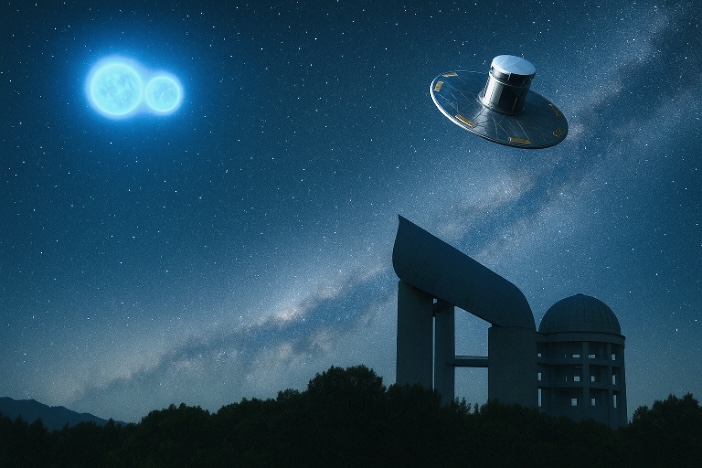
Figure one:The observation imaginary diagram of binary stars with LAMOST and Gaia (Image: Jie Yu).