Recently, the research team led by Professor Zhu Jianqiang at the Joint Laboratory for High-Power Laser Physics, Shanghai Institute of Optics and Fine Mechanics (SIOM), Chinese Academy of Sciences, has achieved new progress in the study of the three-dimensional spatiotemporal evolution of mode fields in multimode lasers. The team investigated the physical mechanisms underlying the spatiotemporal coupling between transverse and longitudinal modes, established a 3D spatiotemporal multi-mode model for multimode lasers, and conducted an in-depth study of the spatiotemporal interactions among these modes. This work enables a quantitative description of the spatiotemporal evolution at any spatial position and temporal slice during light field propagation. The related findings have been published in Laser & Photonics Reviews under the title "3D Spatiotemporal Evolution of the Mode Field in Multimode Lasers."
Multimode lasers show broad application prospects in fields such as industry and medical imaging. Establishing a comprehensive 3D characterization methodology for multimode lasers and achieving a complete characterization of their light fields are crucial for advancing this field.
Addressing the aforementioned challenges, the research team, through precise 3D simulations, realized the 3D spatiotemporal light field distribution under different numbers of transverse and longitudinal modes, as shown in Figure 1. The research reveals that the 3D distribution of the spatiotemporal multi-mode field exhibits significant spatiotemporal speckle characteristics. The volumetric properties of these spatiotemporal speckles are jointly determined by the synergistic effect of the number of transverse and longitudinal modes: the number of longitudinal modes directly influences the temporal coherence length of the light field, while the number of transverse modes determines the spatial speckle size. The combined action of transverse and longitudinal modes collectively dictates the spatiotemporal coherence, thereby affecting the volume of the spatiotemporal speckles in the 3D distribution.
A clear relationship exists between the proportion of transverse modes and spatial coherence, providing a theoretical basis for precisely controlling spatial coherence by manipulating the transverse mode distribution. Based on the influence mechanism of temporal coherence on the instantaneous spatial speckle intensity distribution (as shown in Figure 2), when the time delay reaches several times the coherence time, two entirely uncorrelated instantaneous spatial speckle patterns can be obtained. This characteristic holds significant application value in fields such as interferometry. Under time integration, the rate of change of the RMS of the 2D light field distribution is directly related to the multiple of the coherence time, while the order of the transverse modes has a relatively limited impact on the final RMS value. This discovery deepens the understanding of the nature of speckle pattern integration effects and provides more comprehensive and in-depth theoretical guidance for optimizing the spatiotemporal characteristics of imaging sources and improving imaging precision.
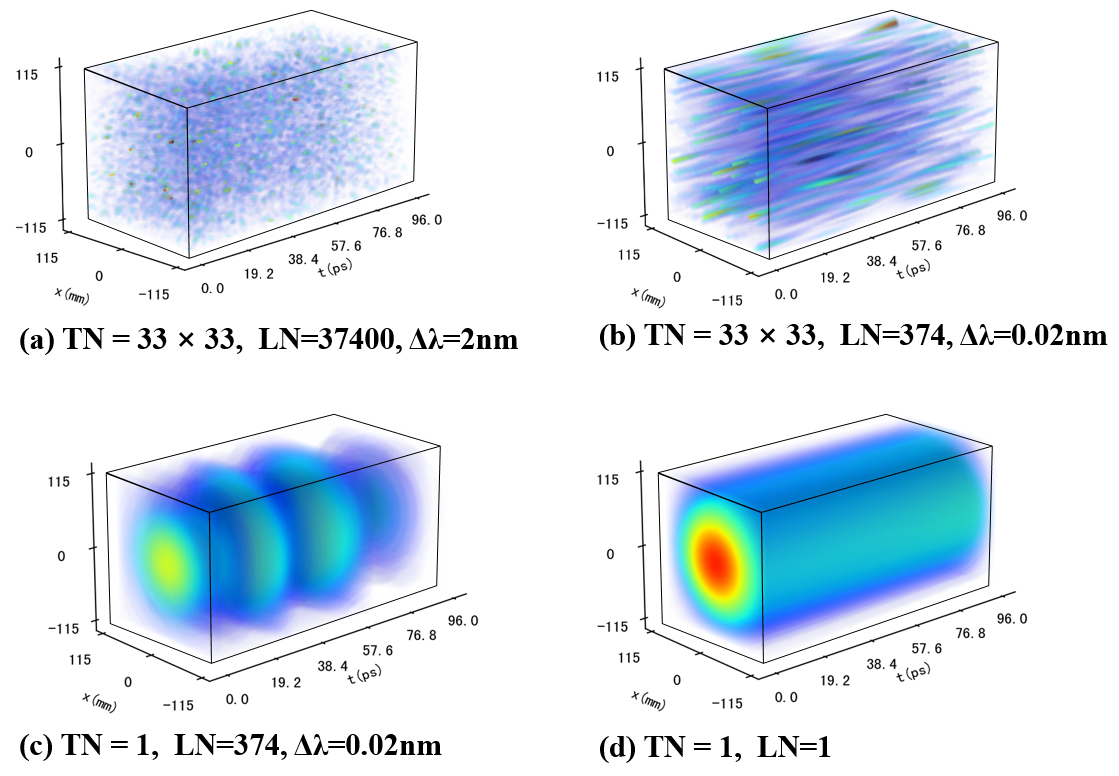
Fig.1 3D spatiotemporal light field distribution. a) spatiotemporally partially coherent light, b) spatial incoherent and temporally coherent light, c) spatially coherent and temporally incoherent light, d) fully spatiotemporal coherent light. TN represents the number of transverse modes, LN represents the number of longitudinal modes, and represents the spectral width.
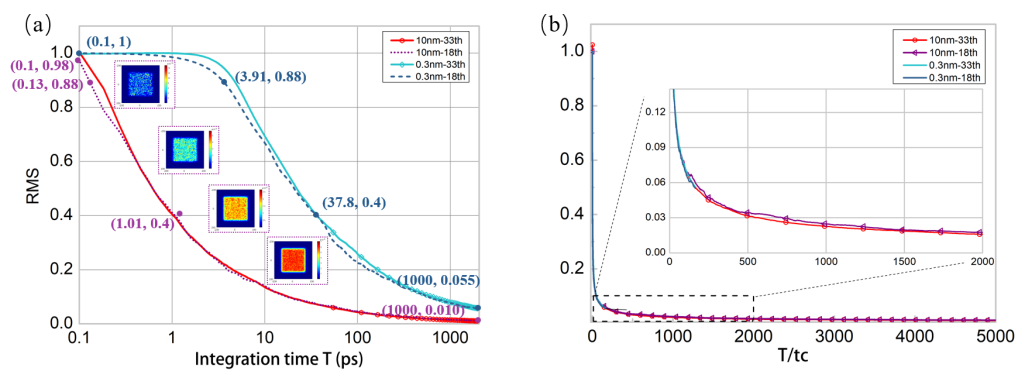
Fig.2 RMS variation curves of the 2D light field distribution at different time integrations. a) The result of RMS variation with time integration, b) the variation in RMS with the normalized coherence time.
This research was supported by the Chinese Academy of Sciences Strategic Priority Research Program.
The link of the paper is https://onlinelibrary.wiley.com/doi/10.1002/lpor.202501544.


