
On March 6, 2025, a significant research achievement in deep-sea fish studies, led by Researcher He Shunping of the Chinese Academy of Sciences' Global Trench Research Team and involving scientists from institutions including the Institute of Deep Sea Science and Engineering, the Institute of Hydrobiology of the Chinese Academy of Sciences, and Northwestern Polytechnical University, was published in the international top-tier journal Cell under the title "Evolution and genetic adaptation of fishes to the deep sea."Supported by the Global Trench Exploration and Diving program (Global TREnD) deployed by the Chinese Academy of Sciences, this study achieved multi-dimensional breakthroughs from the genetic to ecosystem levels for the first time, leveraging a deep-sea and abyssal fish sample library acquired through China's independently developed deep-diving technologies.
This study utilized the research vessels “TAN SUO YI HAO” and “TAN SUO ER HAO”, as well as China's independently developed deep-diving equipment including the 4,500-meter-class manned submersible “Shenhaiyongshi”, the Full-Ocean-Depth manned submersible “Fendouzhe”, and Full-Ocean-Depth landers "In-situ Experiment" and "Tianya". Through a series of scientific expeditions to the Mariana Trench, Yap Trench, Diamantina Deep, Valdivia-Gearns Deep, Southwest Indian Ocean Hydrothermal Vents Zone, Philippine Sea Basin, and South China Sea, the study covered almost the entire depth range of deep-sea fish habitats (1,218-7,730 meters).Scientific surveys obtained samples of 11 deep-sea fish species belonging to six typical deep-sea fish groups, including six hadal zone (>6,000 meters) species.

Sampling information and morphological characteristics of 11 deep-sea fish species
This study generated genome assemblies of 12 species, including 11 deep-sea fishes. The findings reconstructed the teleost deep-sea colonization history and revealed the overall impact of the deep-sea environment on fishes. Interestingly, the results question the previously assumed linear correlation between trimethylamine oxide (TMAO) content and depth. By contrast, the study observed a convergent aa replacement in the rtf1 gene in most deep-sea fishes under 3,000 m, and in vitro experiments suggest that this mutation can influence transcriptional efficiency, which is likely to be advantageous in the deep-sea environment. Moreover, this study underlines the pervasive impact of human activities, as the presence of persistent organic pollutants in species from the Mariana Trench was detected.
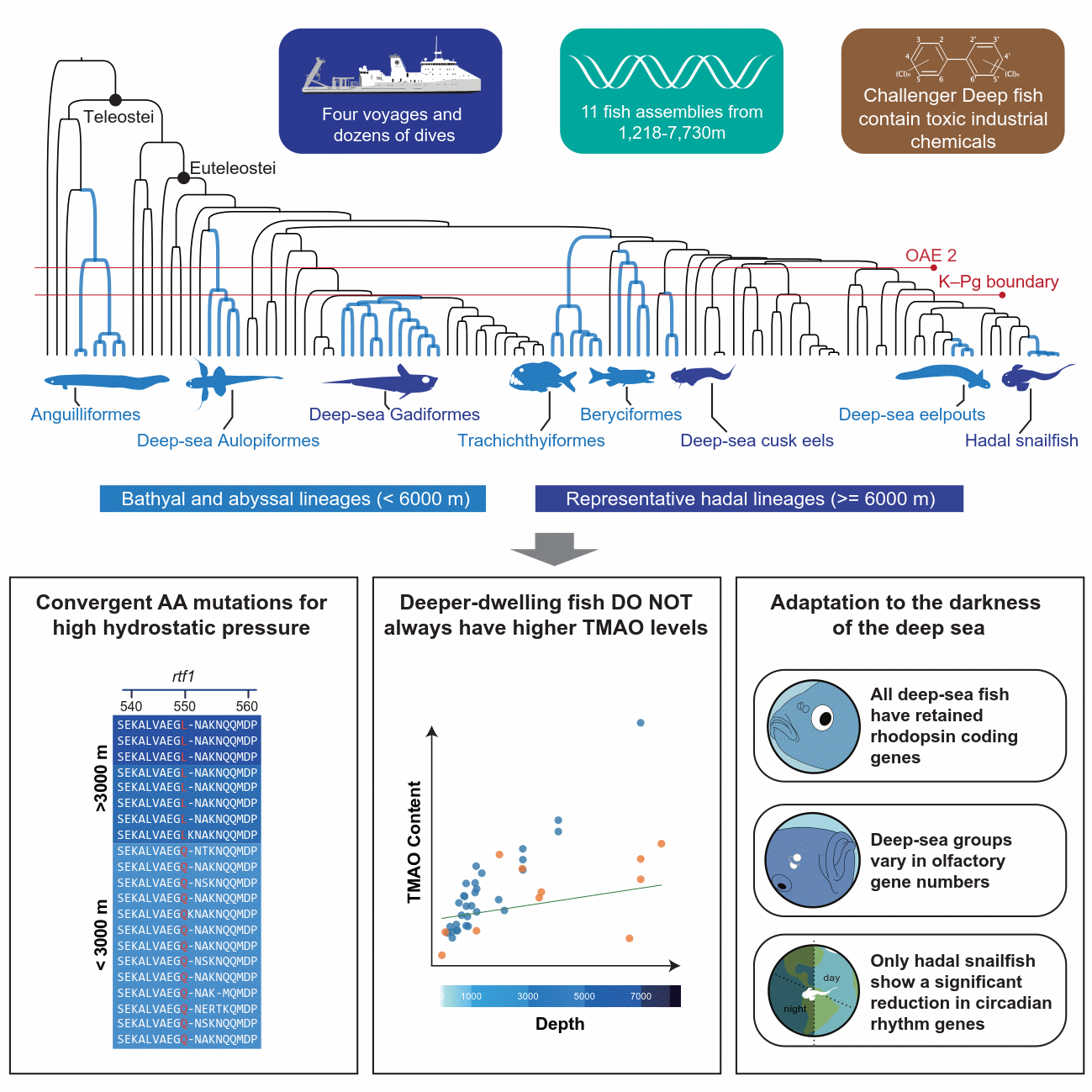
Graphical Abstract
This study was supported by the Strategic Priority Research Program (Class B) of the Chinese Academy of Sciences, the International Partnership Program of the Chinese Academy of Sciences,the National Key Research and Development Program, the National Natural Science Foundation of China,the Major Science and Technology Program of Hainan Province, and the "Global Trench Exploration and Diving program(Global TREnD)".
Postdoctoral Fellow Xu Han from the Institute of Deep Sea Science and Engineering, Chinese Academy of Sciences, is the first author of this study. Associate Researcher Fang Chengchi and Postdoctoral Fellow Wang Cheng from the Institute of Hydrobiology, Chinese Academy of Sciences, Dr. Xu Wenjie from Northwestern Polytechnical University, and SongYue from the Qingdao BGI Research Institute are co-first authors. Researcher He Shunping, Professor Wang Kun, and Researcher Zhang Haibin serve as co-corresponding authors of this study.

