Recently, a research team led by Researcher Jiang Ling and Academician Yang Xueming from Dalian Light Source Research Laboratory, in collaboration with Professor Li Jun's research group from Tsinghua University, utilized their independently developed infrared spectroscopy experimental method for neutral clusters based on Dalian Coherent Light Source to discover multiple prismatic and cage-like structures in ice-like neutral water cluster heptamers. It provides a new idea for uncovering the evolution mechanism of the hydrogen bond network from liquid water to microice.
The mutual transformation between liquid water and ice is a widespread natural phenomenon. However, due to the extremely rapid and difficult-to-control changes in the dynamic hydrogen bonds within liquid water and ice, precisely analyzing the formation mechanism of liquid water to ice remains a huge scientific challenge. Studying the process by which water molecules gradually grow into water molecule clusters, liquid water and ice is crucial for understanding the microstructure and formation mechanism of ice. Infrared spectroscopy is one of the most effective methods for studying the structure of substances. Unlike ionic clusters, neutral water clusters have received little experimental research due to their lack of charge and difficulty in detection. Therefore, achieving infrared spectroscopy research on mass-selective neutral water clusters has long been a dream of scientists.
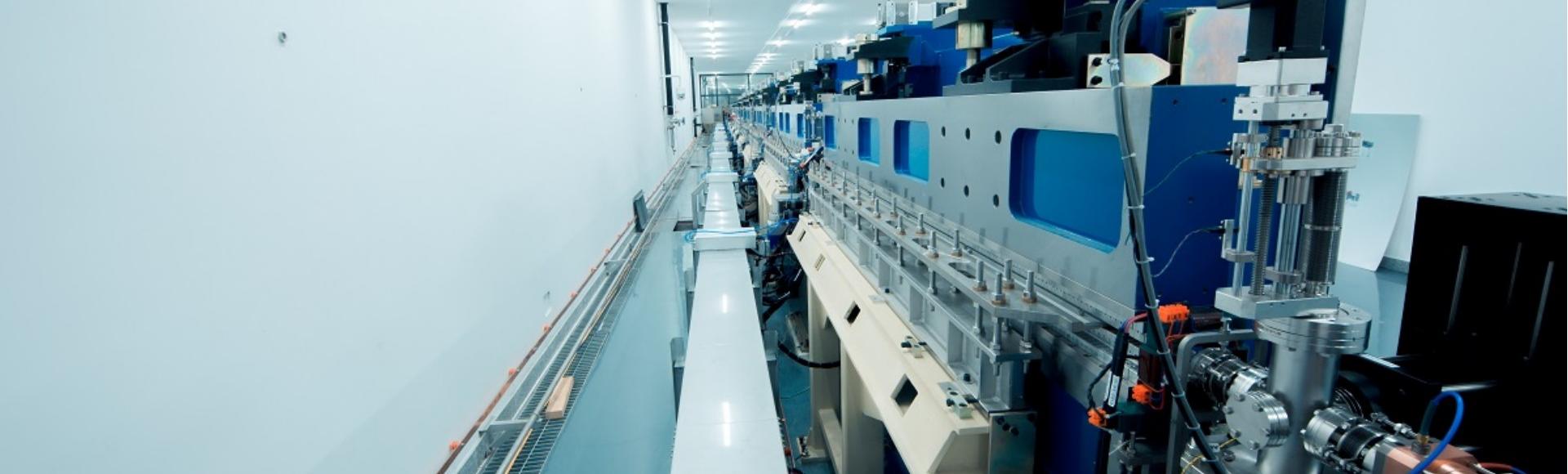
To achieve precise detection and structural analysis of neutral water clusters, the team led by Jiang Ling and Yang Xueming has made breakthroughs in related experimental techniques in recent years. They independently developed an infrared spectroscopy experimental method for neutral clusters based on the Dalian Extreme ultraviolet Free Electron Laser (Dalian Coherent Light Source). The highly sensitive detection of mass-selective neutral water clusters and the study of infrared spectra were achieved for the first time [The Journal of Physical Chemistry Letters, 2020, 11, 851]. By using this method, it was discovered that the three-dimensional structure of the smallest water droplet is composed of five water molecule clusters [Proc. NAT L. Acad. Sci. U.S.A., 2020, 117, 15423], and several new structures of the smallest molecular ice cube were discovered. The bonding characteristics of water clusters were revealed [Nat. Commun., 2020, 11, 5449]. This unique experimental method also opens the door for conducting research on the infrared spectroscopy and structure of various neutral clusters.
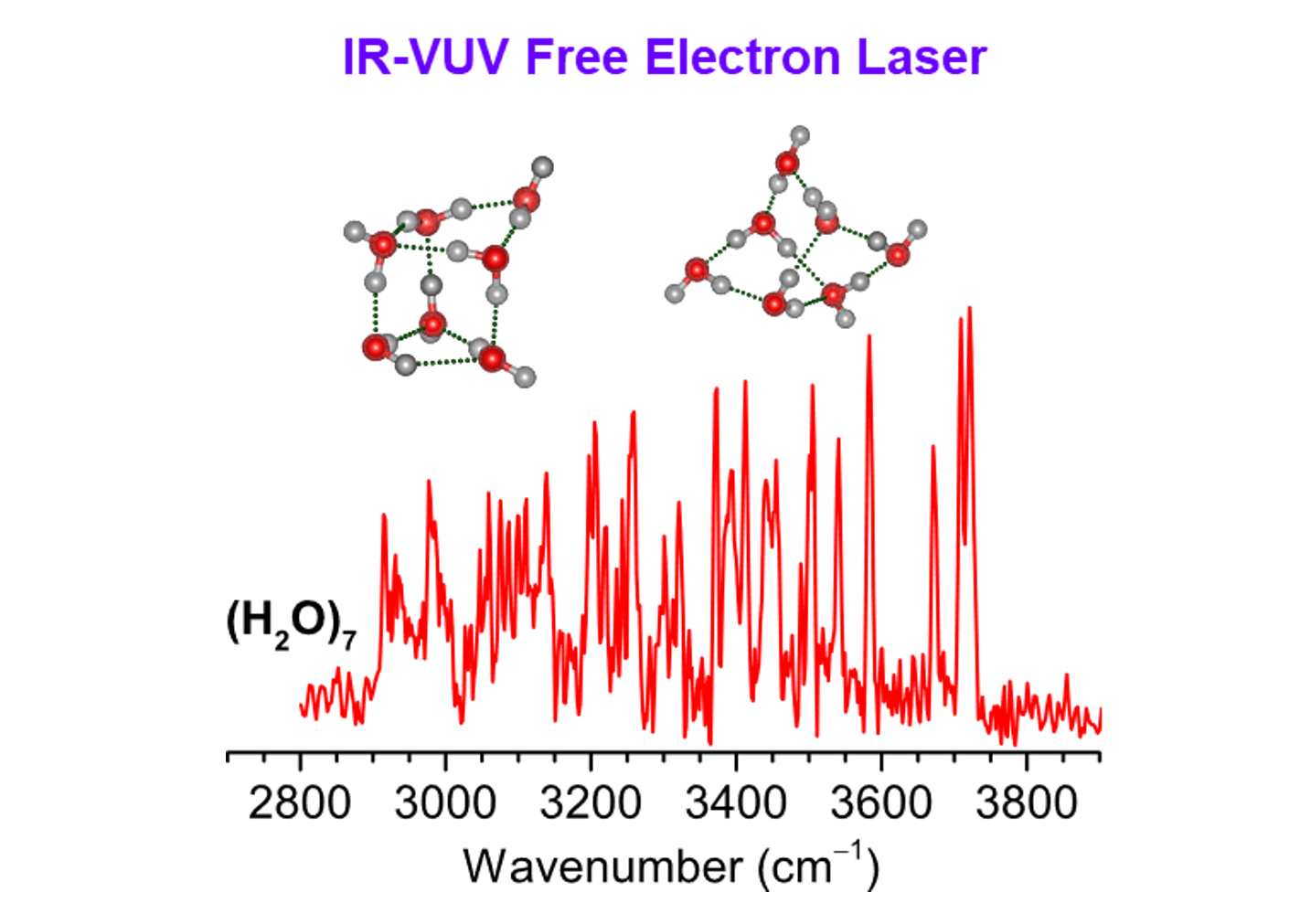
Water molecule heptamer (H2O)7 is regarded as the amorphous precursor of the ice-like cube structure. Recently, Jiang Ling and Yang Xueming's team used a self-developed neutral cluster infrared spectroscopy experimental device to determine the infrared spectrum of mass-selective neutral (H2O)7, presenting complex spectral characteristics. The research group led by Li Jun from Tsinghua University adopted high-precision quantum chemistry theoretical methods to calculate various stable structures and infrared spectra of (H2O)7. The theoretical and experimental results are highly consistent. Studies have shown that (H2O)7 has multiple structures with similar energy at specific temperatures, which are mainly divided into prismatic and ccage structures. Among them, the prismatic structure contributes more to the infrared spectrum. The complexity of this special structure stems from the competition of structural models between the growth of hydrogen bonds in prismatic (H2O)6 and the breaking of hydrogen bonds in cubic (H2O)8. This work reveals the microstructure during the transition from liquid water to ice, which holds significant scientific importance for research in fields such as atmospheric science and water science.
The relevant results were published in Cell Reports Physical Science. This work was supported by the National Natural Science Foundation of China's "Frontiers in Dynamic Chemistry" Science Center Project, the Key Support Project of the Major Research Program on "Cluster Structure, Function and Multi-level Evolution", the Strategic Priority Research Program of the Chinese Academy of Sciences (B) "Essence and Regulation of Energy Chemical Conversion", the Science Challenge Project, and the Dalian Coherent Light Source Special Fund Project, among others. (Text and images are reprinted from the homepage of Dalian Institute of Chemical Physics, Chinese Academy of Sciences)