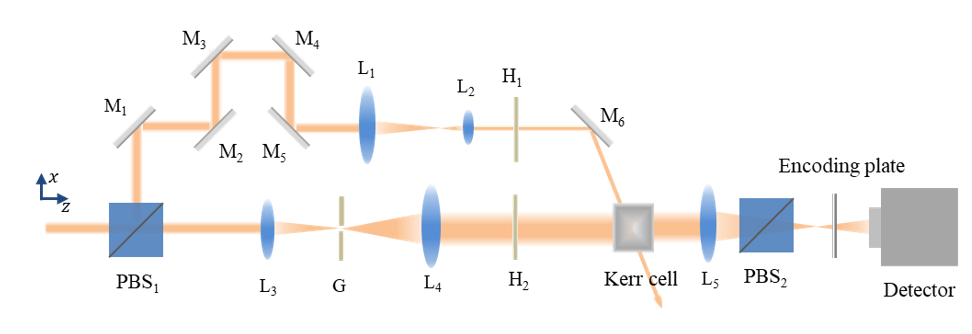
Recently, the Joint Laboratory on High-Power Laser Physics, in collaboration with Professor Rick Trebino from the Georgia Institute of Technology, has made research progress in phase retrieval algorithms for ultrashort pulse measurement. The research team proposed a novel Multi-grid Parallel Ptychographic Algorithm (MPPA), significantly enhancing the pulse reconstruction capability of Frequency-Resolved Optical Gating (FROG) technology under complex conditions. The related research findings were published in Optics Express under the title "Multi-grid parallel ptychographic algorithm for frequency-resolved optical gating."
Accurate measurement of ultrashort laser pulses is one of the core challenges in ultrafast optics. Frequency-Resolved Optical Gating (FROG) reconstructs pulses by measuring their time-delay-versus-frequency distribution (trace) and using iterative algorithms. However, traditional reconstruction algorithms are susceptible to noise interference or incomplete data, leading to convergence stagnation or error accumulation. Especially when handling high-noise, large-bandwidth, or extremely short pulses, the stability and computational efficiency of existing methods face severe challenges.
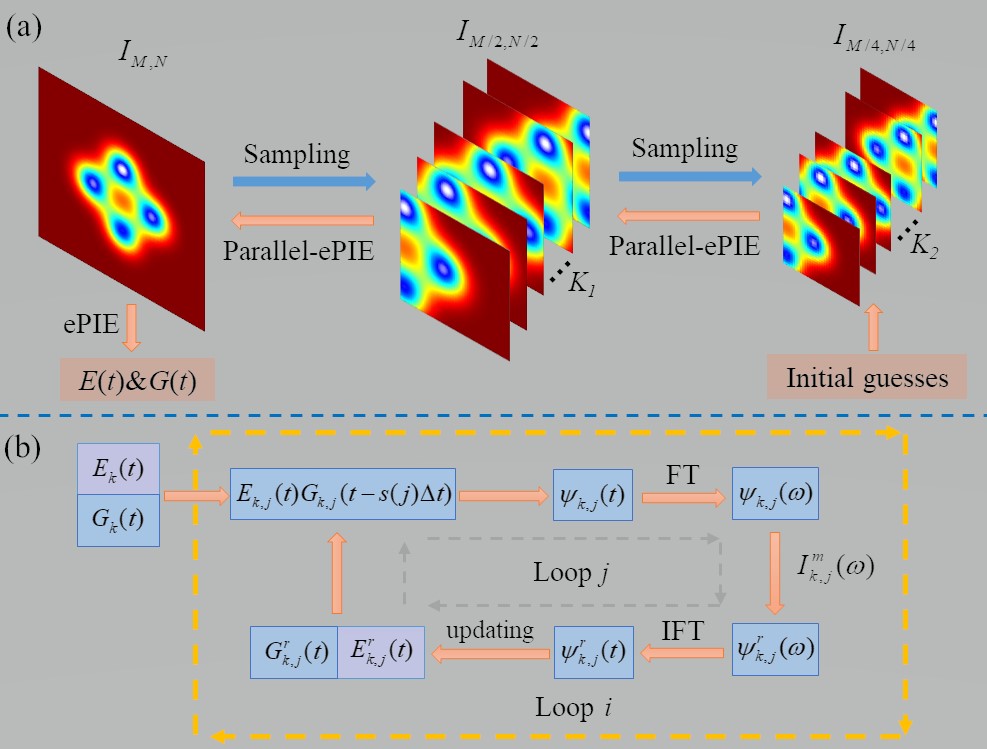
Figure 1: (a) Schematic of the MPPA principle; (b) Flowchart of the ePIE iteration process.
In this work, the MPPA algorithm decomposes the original FROG trace into multi-scale sub-traces through flexible sampling. These sub-traces are processed in parallel to rapidly escape local minima. Based on an improved ePIE (extended ptychographical iterative engine) algorithm, MPPA supports multi-threaded parallel computing, significantly accelerating convergence speed. It also dynamically adjusts iteration parameters by introducing weighting factors, ensuring stable and rapid convergence even under extreme conditions such as low signal-to-noise ratio (SNR) or severely incomplete data. Through numerical simulations and experimental validation, the MPPA algorithm demonstrated high precision, high noise immunity, and high robustness in pulse reconstruction—without relying on any prior information. It achieved accurate pulse reconstruction even under strong noise interference or with only 1/10 of the delay or spectral data, with an average error below 1%. Its convergence rate is nearly ten times higher than traditional Ptychography and projection algorithms, and it achieves a reconstruction success rate exceeding 90% even for extremely complex pulses (time-bandwidth product, TBP > 80). The MPPA algorithm provides a more efficient and reliable solution for diagnosing ultrashort laser pulses under increasingly complex scenarios.
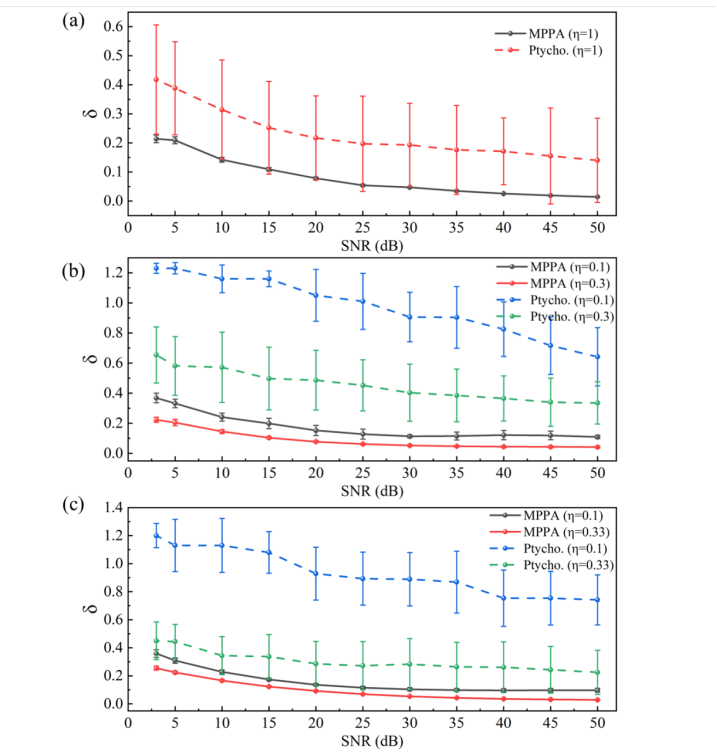
Figure 2: Comparison of reconstruction errors between MPPA and Ptychography algorithms under varying levels of noise and incomplete traces.
This research received support from the National Natural Science Foundation of China, the Shanghai Yangfan Program, projects under the Chinese Academy of Sciences' Pioneer Initiative, and others.
https://doi.org/10.1364/OE.543471