Recently, the Joint Laboratory on High-Power Laser Physics has made significant progress in single-shot characterization technology for complex synthesized laser pulses. Based on an improved broadband Transient Grating Frequency-Resolved Optical Gating (TG-FROG) technique, the research team achieved single-shot complete characterization of complex high-power laser pulses and revealed the dynamic evolution mechanisms of ultrashort pulses during nonlinear frequency-conversion processes. The related research findings were published in Optics Express under the title "Single-shot complete characterization of synthesized laser pulses and nonlinear frequency-conversion process."
Synthesized laser fields (combining pulses of different polarizations, central wavelengths, or durations) have important applications in ultrafast spectroscopy, high-harmonic generation, and other fields. However, their precise measurement faces multiple challenges. Traditional methods are limited by polarization sensitivity, insufficient measurement bandwidth, or the need for multiple shots, making it difficult to meet the real-time diagnostic requirements of high-power, low-repetition-rate laser systems. Furthermore, the lack of effective observational tools for the dynamic characteristics of nonlinear frequency conversion in complex pulses hinders the optimization and application expansion of laser systems.
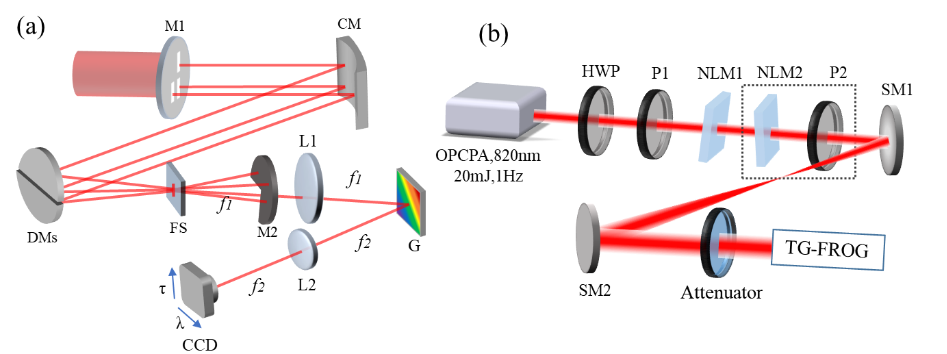
Figure 1: (a) Single-shot broadband TG-FROG setup; (b) Optical layout for broadband nonlinear frequency-conversion process and two-pulse measurement experiment.
To address these challenges, the research team developed an improved TG-FROG measurement technique. By adopting a self-referenced reflective design combined with a broadband imaging spectrometer, the system achieves single-shot measurements covering at least 460 nm of spectral range, with a temporal resolution of 5.81 fs and a spectral resolution better than 0.13 nm. Using this technique, the team achieved simultaneous observation of the waveform and spectral evolution of fundamental-frequency pulses and second-harmonic pulses during nonlinear frequency conversion, revealing complex modulation effects such as spectral broadening, redshift, and multi-peak temporal structures under high-energy injection. Additionally, the method successfully characterized temporally and spectrally separated two-color pulses generated via cascaded second-harmonic generation (SHG), resolving their time delay (208.4 fs) and relative phase (0.29 rad) while overcoming phase ambiguity limitations. This approach provides a powerful tool for optimizing pulse contrast and waveform in ultrafast laser systems and studying complex physical processes.
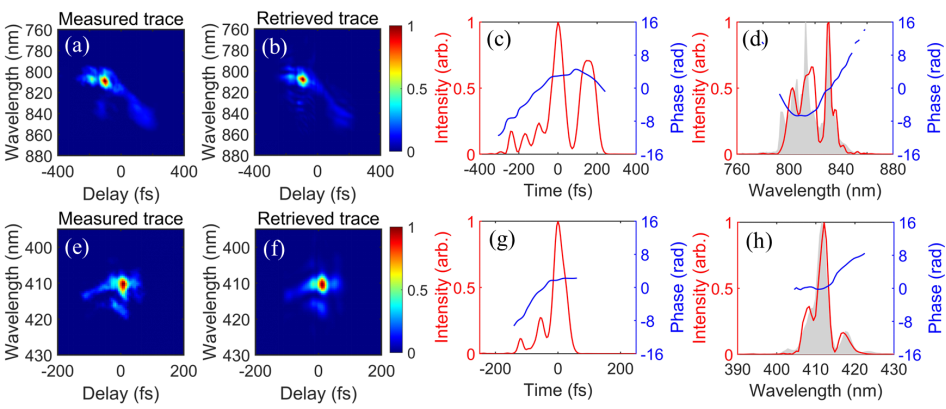
Figure 2: TG-FROG simultaneous measurement results of fundamental and second-harmonic pulses during SHG under high-injection energy.
This work received support from the National Natural Science Foundation of China, projects under the Chinese Academy of Sciences’ Pioneer Initiative, the CAS Innovation Fund, and others.
https://doi.org/10.1364/OE.527539