Atomic gas is the basic material that all galaxies are formed from. The evolution of galaxies is mostly a procedure of accreting atomic gas from the intergalactic medium and then converting it into stars.
For this reason, observation and exploration of atomic gas in and around galaxies is crucial to the study of galaxy formation and evolution models. The most direct method of exploring atomic gas is through observation of the 21-cm fine structure line emission of atomic hydrogen in the radio waveband.
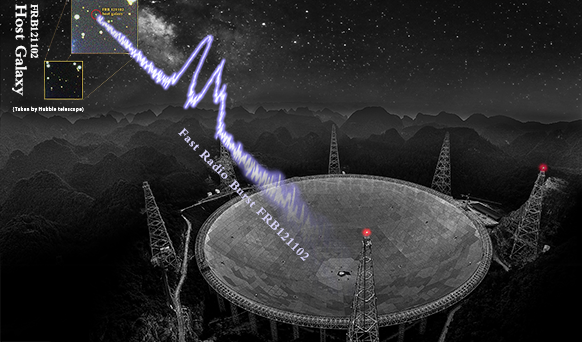
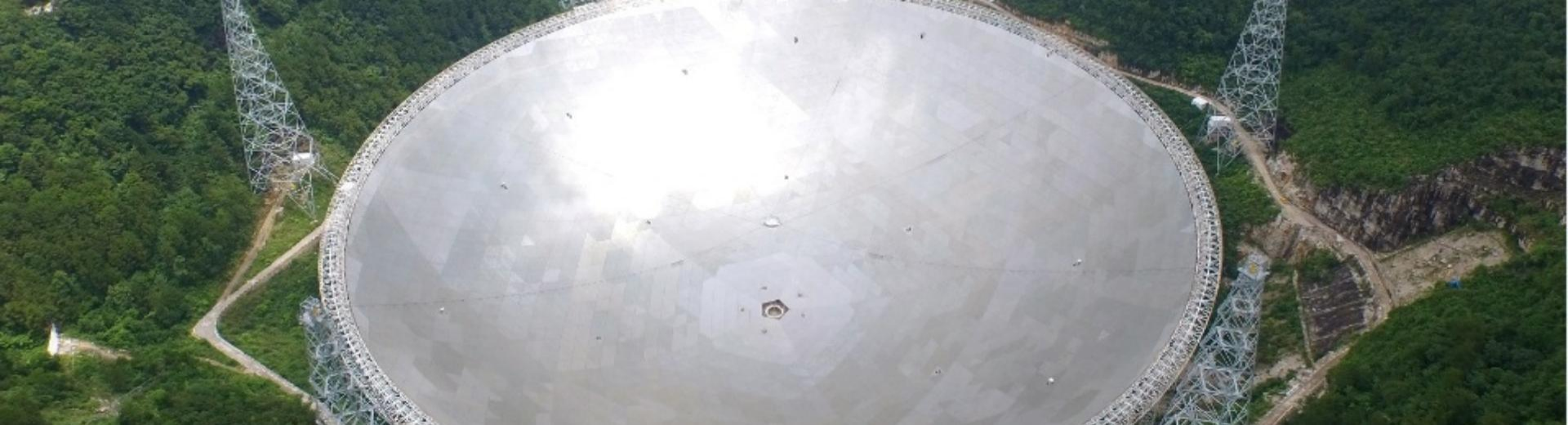
Recently, using the Five-hundred-meter Aperture Spherical Telescope (FAST) 19-beam receiver, an international team led by XU Cong, a researcher from the National Astronomical Observatories of the Chinese Academy of Sciences (NAOC), carried out deep mapping observations of 21-cm line emission in a region around the famous compact group of galaxies “Stephan’s Quintet,” and discovered a very large atomic gas structure with a length of about 2 million light years (about 20 times the size of the Milky Way).
Their findings were published in Nature on Oct. 19.
FAST is currently the largest and most sensitive single-dish radio telescope in the world, and its 19-beam receiver is the largest L-band multibeam feed array for 21-cm line observations. The full commissioning of the FAST 19-beam receiver opened a new window on atomic gas in the Universe, particularly for low density diffuse gas far away from galaxies.
"This is the largest atomic gas structure ever found around a galaxy group," said XU. The observations reached a sensitivity of 1σ=4.2×1016 cm-2 per channel (Δv=20 km s-1; angular-resolution=4’), making them currently the most sensitive observations of atomic hydrogen 21-cm line emission at this angular resolution.
Ever since its discovery by the French astronomer Edouard Stephan in 1877, Stephan’s Quintet has continued revealing puzzles related to the complex web of galaxy-galaxy and galaxy-intragroup medium interactions in the group.
The new observations show that large-scale, diffuse, low density gas (with a column identity less than 1018cm-2) exists far away from the center of the group, and it is likely that the gas has been there for ~1 giga years. The observations challenge the current theory of galaxy-group formation/evolution because it is not clear how the low-density atomic gas can survive ionization by the intergalactic UV background on such a long time scale.
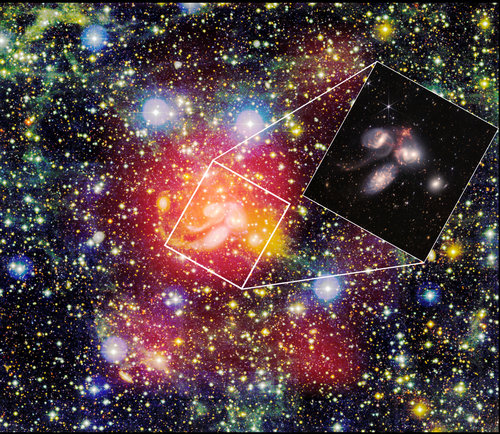
A map of the atomic hydrogen (HI) 21-cm line emission (shown as the red haze) in the vicinity of Stephan's Quintet, a famous compact group of galaxies discovered in 1887, overlaid on a deep optical color image. (Image by NASA, ESA, CSA, and STScI)
The paper is available at https://www.nature.com/articles/s41586-022-05206-x