Log in Sign up 中文
English
  • Home
  • About
  • Facilities
    • Material
    • Earth System and Environment
    • Engineering Technology
    • Space and Astronomy
    • Particle and Nuclear Physics
    • Energy
    • Biology
  • News
    • News & Updates
    • Research Highlights
  • Notice
  • User Portal
  • Home
  • Facilities
    • Material
    • Earth System and Environment
    • Engineering Technology
    • Space and Astronomy
    • Particle and Nuclear Physics
    • Energy
    • Biology
  • News
    • News & Updates
    • Research Highlights
  • Notice
  • User Portal

Five-hundred-meter Aperture Spherical radio Telescope (FAST)

  1. Home>Facilities>Space and Astronomy>Five-hundred-meter Aperture Spherical radio Telescope (FAST)>News
  • News
  • Notice
  • Equipment
  • Contact
  • Data Resource
News
  • Chinese Scientists Unveil Young Pulsar's Origin in Galactic Halo
    Chinese Scientists Unveil Young Pulsar's Origin in Galactic Halo
    Chinese astronomers have unveiled the mysterious origins of a young pulsar located in the Milky Way's halo, providing compelling observational evidence for the study of such objects' formation. The study was conducted by a team from the Xinjiang Astronomical Observatory of the Chinese Academy of Sciences。
    Chinese astronomers have unveiled the mysterious origins of a young pulsar located in the Milky Way's halo, providing compelling observational evidence for the study of such objects' formation.The study, conducted by a team from the Xinjiang Astronomical Observatory (XAO) of the Chinese Academy of Sciences, was recently published in The Astrophysical Journal.By utilizing long-term observational...
    Jun 09, 2026
  • Scientists Identify Millisecond Pulsar PSR J0435+3233, Challenging Accretion-Driven Paradigm of Pulsar Formation
    Scientists Identify Millisecond Pulsar PSR J0435+3233, Challenging Accretion-Driven Paradigm of Pulsar Formation
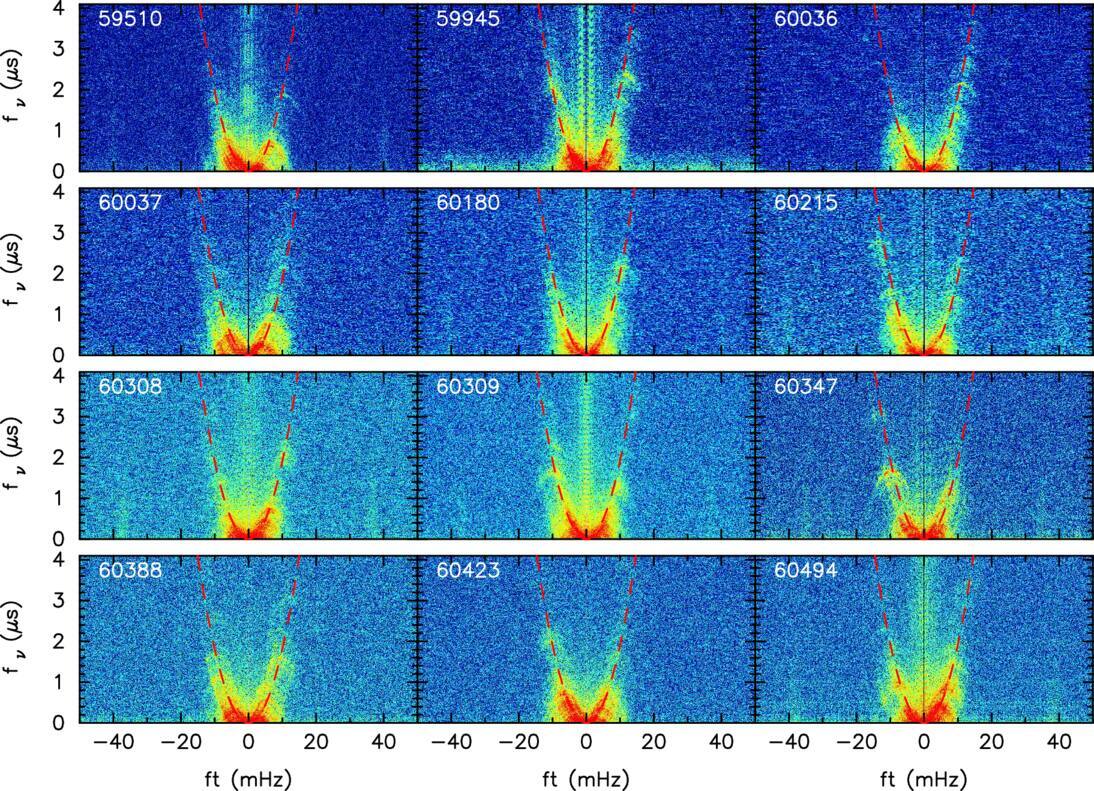
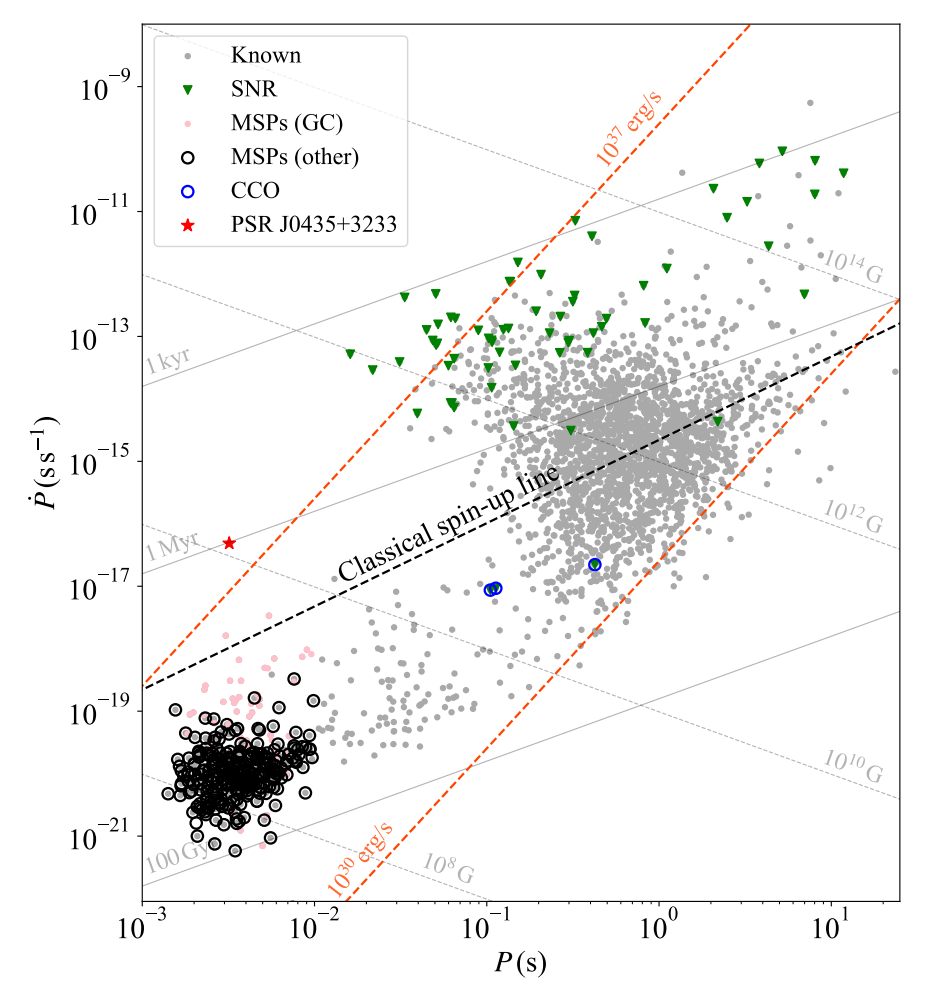
    A research team led by Prof. WANG Na from the Xinjiang Astronomical Observatory of the Chinese Academy of Sciences has conducted in-depth observations of the millisecond pulsar PSR J0435+3233 using the Five-hundred-meter Aperture Spherical radio Telescope (FAST). The team found that PSR J0435+3233 has a high spin-down rate—two orders of magnitude greater than that of any other known millisecond pulsar in the Milky Way.
    A research team led by Prof. WANG Na from the Xinjiang Astronomical Observatory (XAO) of the Chinese Academy of Sciences (CAS) has conducted in-depth observations of the millisecond pulsar PSR J0435+3233 using the Five-hundred-meter Aperture Spherical radio Telescope (FAST).The team found that PSR J0435+3233 has a markedly high spin-down rate—two orders of magnitude greater than that of any ot...
    Apr 14, 2026
  • China's Giant Radio Telescope Observations Unravel Origin of Cosmic Enigmatic Flashes
    China's Giant Radio Telescope Observations Unravel Origin of Cosmic Enigmatic Flashes
    Through studying the observation data of China's gigantic radio telescope located in the country's southwestern Guizhou Province, an international research team has uncovered compelling new evidence supporting a binary-system origin for at least some fast radio bursts (FRBs), one of the most enigmatic phenomena in modern astrophysics.
    An aerial drone photo taken on Jan. 16, 2026 shows China's Five-hundred-meter Aperture Spherical Radio Telescope (FAST) under maintenance in southwest China's Guizhou Province. (Xinhua/Ou Dongqu)Through studying the observation data of China's gigantic radio telescope located in the country's southwestern Guizhou Province, an international research team has uncovered compelling new evidence sup...
    Jan 19, 2026
  • Chinese Scientists Discover Rare Eclipsing Pulsar
    Chinese Scientists Discover Rare Eclipsing Pulsar
    On May 23, 2025, an latest research achievement by Chinese scientists was published online in the international academic journal “Science”. The research team from the National Astronomical Observatories of the Chinese Academy of Sciences discovered a rare millisecond pulsar by China's Five-hundred-meter Aperture Spherical Telescope (FAST). It orbits with its companion star in a period of 3.6 hours, and is eclipsed by the companion star for one-sixth of the time (i.e., an eclipse, similar to a solar or lunar eclipse). This discovery is of great significance for the study of stellar evolution theory, compact star accretion physics, and the gravitational wave source of binary mergers .
    On May 23, 2025, an latest research achievement by Chinese scientists was published online in the international academic journal “Science”. The research team from the National Astronomical Observatories of the Chinese Academy of Sciences discovered a rare millisecond pulsar by China's Five-hundred-meter Aperture Spherical Telescope (FAST). It orbits with its companion star in a period of 3.6 ...
    Jun 13, 2025
  • FAST Reveals Mystery of Fast Radio Bursts from the Universe
    FAST Reveals Mystery of Fast Radio Bursts from the Universe
    Fast radio burst (FRB) is a mysterious radio burst that lasts only a few milliseconds, the study of its origin is a hot topic in astrophysics. The research team made observations with FAST reveals the new physics of millisecond radio bursts in the universe. Two research results on FRB detection were published in the international scientific journal Nature in succession. This is the first time that a completely independent achievement based on the data of China's ground-based telescopes were published on this top journal.
    In the vast universe, some extremely strong radio waves occasionally blink, with duration of only milliseconds. Such fast radio bursts were discovered by astronomers in 2007. Puzzling questions arise: Who sent them? What information is conveyed by these radio bursts?The Five-hundred-meter Aperture Spherical Radio Telescope (FAST) has revealed some mystery of the fast radio bursts, according to ...
    Jun 12, 2025
  • First in the world! Wuhan University team reveals new discovery of black holes in Nature
    First in the world! Wuhan University team reveals new discovery of black holes in Nature
    Relying on the advantages of FAST's high sampling rate and detection sensitivity, a research team has carried out high-precision observations of radio continuum spectrum variation and polarization for GRS1915+105 for the first time, and discovered a faint radio pulse in the black hole. This achievement is the first international observation of sub second level low-frequency radio quasi periodic oscillations in micro quasars. It reveals the complex dynamic characteristics of black hole jets. It opens a new window for radio observations and theoretical studies of black holes. This achievement was published in the Nature magazine in July 2023.
    Nature recently published the latest research results on black holes by Prof. Wang Wei’s team from the Department of Astronomy, School of Physics and Technology, Wuhan University.The paper is entitled “Sub-second periodic radio oscillations in a microquasar”. Wuhan University is the first author, while. Prof. Tian Pengfu, Zhang Ping, and Wang Wei from Wuhan University and PhD student Wang P...
    Aug 27, 2023
  • Scientists Find Key Evidence for Existence of Nanohertz Gravitational Waves
    Scientists Find Key Evidence for Existence of Nanohertz Gravitational Waves
    The research team used the FAST telescope to collect pulsar timing data for 3 years and 5 months and found evidence for nanohertz gravitational waves. A statistical significance of spatial quadrupole correlation at 4.6 sigma level (false alarm rate less than 0.000002) was obtained near the nanohertz. This is the crucial evidence for nanohertz gravitational waves. The Chinese research team and four other international teams reported this result simultaneously. It indicates that we have achieved a significant breakthrough in sync with the international community. This achievement was published in July 2023 on Astronomy and Astrophysics Research and was selected as one of the top ten scientific breakthroughs in 2023 by the Science magazine.
    A group of Chinese scientists has recently found key evidence for the existence of nanohertz gravitational waves, marking a new era in nanoHertz gravitational wave research. The research was based on pulsar timing observations carried out with the Five-hundred-meter Aperture Spherical radio Telescope (FAST).The research was conducted by the Chinese Pulsar Timing Array (CPTA) collaboration, whic...
    Jun 28, 2023
  • FAST finds the missing link in the evolution of the spider pulsar system
    FAST finds the missing link in the evolution of the spider pulsar system
    Spider pulsars are important for studying the evolution of binary stars, but the understanding of their evolution is limited to theoretical predictions. Using FAST's ultra-high sensitivity and strong detection capabilities, a research team has found a pulsar binary system with the shortest period so far. Afterwards, they proved that the spider pulsar binary is in a critical state of transition from a "red backed spider" to a "black widow". It fills the crucial evidence gap in the evolution process of such binary systems. This achievement was published on Nature in June 2023.
     Picture of M71E (the pulsar binary on the right of the figure),FAST(on the bottom of the figure) and the globular cluster M71 (background).(Credit: ScienceApe/CAS/NAOC)The international academic journal Nature published online in the form of Accelerated Article Preview, on June 20, 2023, a research result led by a research group from the National Astronomical Observatories of the Chinese A...
    Jun 26, 2023
  • Magnetic field reversal in the turbulent environment around a repeating fast radio burst
    Magnetic field reversal in the turbulent environment around a repeating fast radio burst
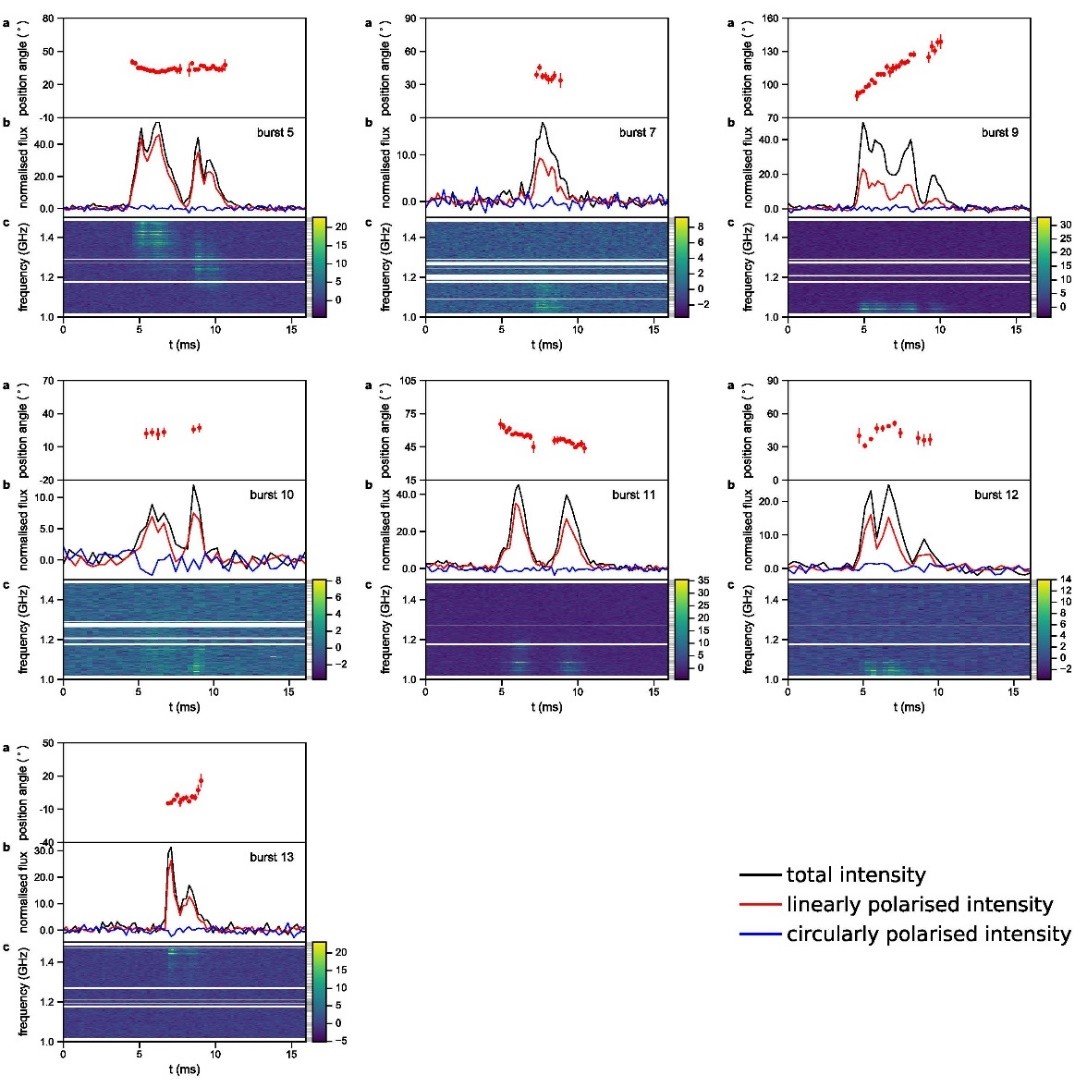
    The world's first sustained active FRB 20190520B was observed and monitored for 17 months by FAST, together with the Green Bank Telescope in the US and the Parkes Radio Telescope in Australian. The research team detected multiple bursts of FRB 20190520. By analyzing the polarization properties of the burst signal, the team found that its Faraday rotation had two drastic changes in positive and negative values. It reveals magnetic field reversal around repeated FRBs. This achievement was published on Science in May 2023.
    Credit: Di Li/ScienceApe/CASFast Radio Bursts (FRBs) are the brightest millisecond-duration cosmic explosions in radio bands. Their unknown origin poses challenges for astronomy as well as physics.The Commensal Radio Astronomy FAST Survey (CRAFTS), a key program of the Five-hundred-meter Spherical radio Telescope (FAST), discovered the world’s first persistently active repeating FRB, known as ...
    May 29, 2023
  • FAST Discovers Largest Atomic Gas Structure Around a Galaxy Group
    FAST Discovers Largest Atomic Gas Structure Around a Galaxy Group
    The research team make an imaging study of the famous compact galaxy group "Stephen Quintuple" and the hydrogen atom gas in the surrounding sky area using FAST. They found a huge atomic gas system with a scale of about 2 million light-years, 20 times larger than our Milky Way. This is the largest atomic gas system detected in the universe so far. FAST's high sensitivity brings unprecedented ability to detect extremely dim object. The result was published in Nature on October 19.
    Atomic gas is  the basic material that all galaxies are formed from. The evolution of  galaxies is mostly a procedure of accreting atomic gas from the  intergalactic medium and then converting it into stars.For  this reason, observation and exploration of atomic gas in and around  galaxies is crucial to the study of galaxy formation and evolution  models. The most direct method of e...
    Oct 21, 2022
12NEXT
MORE

Copyright © 2002 - Chinese Academy of Sciences

Address: No.52 Sanlihe Road, Beijing ,100864