Recently, the exoplanet research group at the School of Astronomy and Space Science, Nanjing University, based on survey data from the National Major Scientific Infrastructure Guo Shoujing Telescope (LAMOST) operated by the National Astronomical Observatories of the Chinese Academy of Sciences (NAOC), combined with other international observational data, successfully determined the age distribution of Ultra-Short-Period (USP) planets. For the first time, they revealed the evolution of the occurrence rate and orbital architecture of USP planet systems with age, providing crucial new clues for research into the formation and evolution of USP planets. These results were published in the international journal Nature Astronomy on April 28, 2025. Nanjing University Ph.D. candidate Tu Peiwei is the first author of the paper, and Professor Xie Jiwei is the corresponding author.
Ultra-Short-Period (USP) planets have a material composition similar to Earth's, but with orbital periods less than 24 hours, they orbit their host stars at extremely close distances. Their surface temperatures can exceed 2000 K, earning them the moniker "Lava Worlds." These extreme planets, completely "absent" in our Solar System and defying traditional understanding, pose a significant challenge to conventional planet formation and evolution theories based on the Solar System. Their origin and evolution remain unsolved mysteries to this day.
Mainstream theories propose that USP planets migrated to their short-period orbits from more distant locations through some mechanism. The possible mechanisms mainly include the following three:
Disk Migration: Planets migrate inward over millions of years (the typical lifetime of a protoplanetary disk) due to interactions with the protoplanetary disk.
High-Eccentricity Migration: Planets are dynamically perturbed onto high-eccentricity orbits. Tidal dissipation near the orbital periapsis then causes the orbit to circularize continuously, eventually forming an isolated USP planet near the periapsis with a high inclination (eccentricity excitation is generally accompanied by inclination excitation). Depending on the speed of orbital excitation, this process can take from millions to billions of years.
Low-Eccentricity Migration: Planets maintain a low eccentricity through interactions with other planets and migrate inward slowly during continuous tidal dissipation. This process can last for billions of years.
Because the timescales of these different migration mechanisms differ and the orbital architecture features they produce are distinct, studying how the occurrence rate and orbital architecture of these planets change over time becomes a key breakthrough for revealing their formation process.
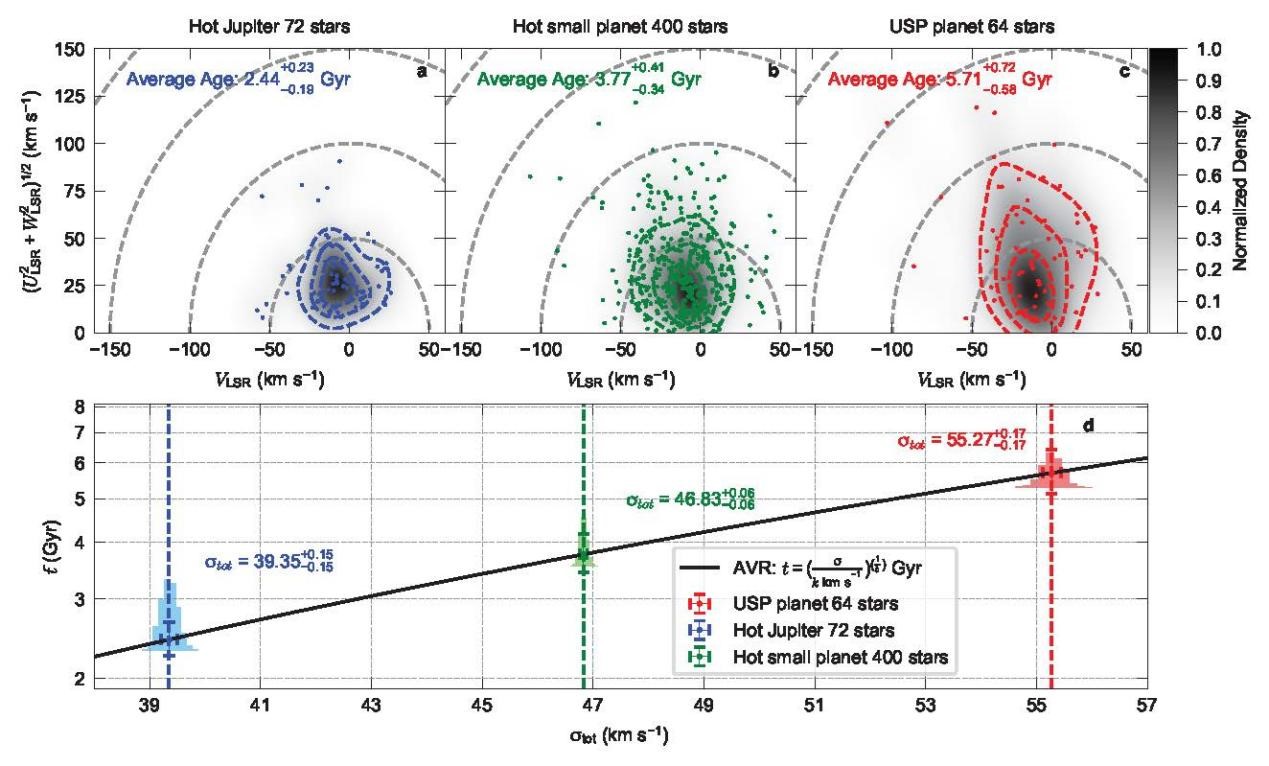
Figure 1: Comparison of the kinematic velocity distribution and kinematic ages of host stars for Ultra-Short-Period planets (red), Hot Jupiters (blue), and short-period low-mass planets (green).
Using the kinematic method for age estimation, the research team first calculated the kinematic parameters and kinematic ages of the host stars of planetary systems using LAMOST and Gaia observational data. The study found that compared to Hot Jupiters and other short-period low-mass planets, the host stars of USP planets have higher kinematic velocities, a higher proportion reside in the Galactic thick disk, and they are older (Figure 1). In other words, compared to other short-period planets, USP planets orbit host stars that are older and kinematically "hotter."
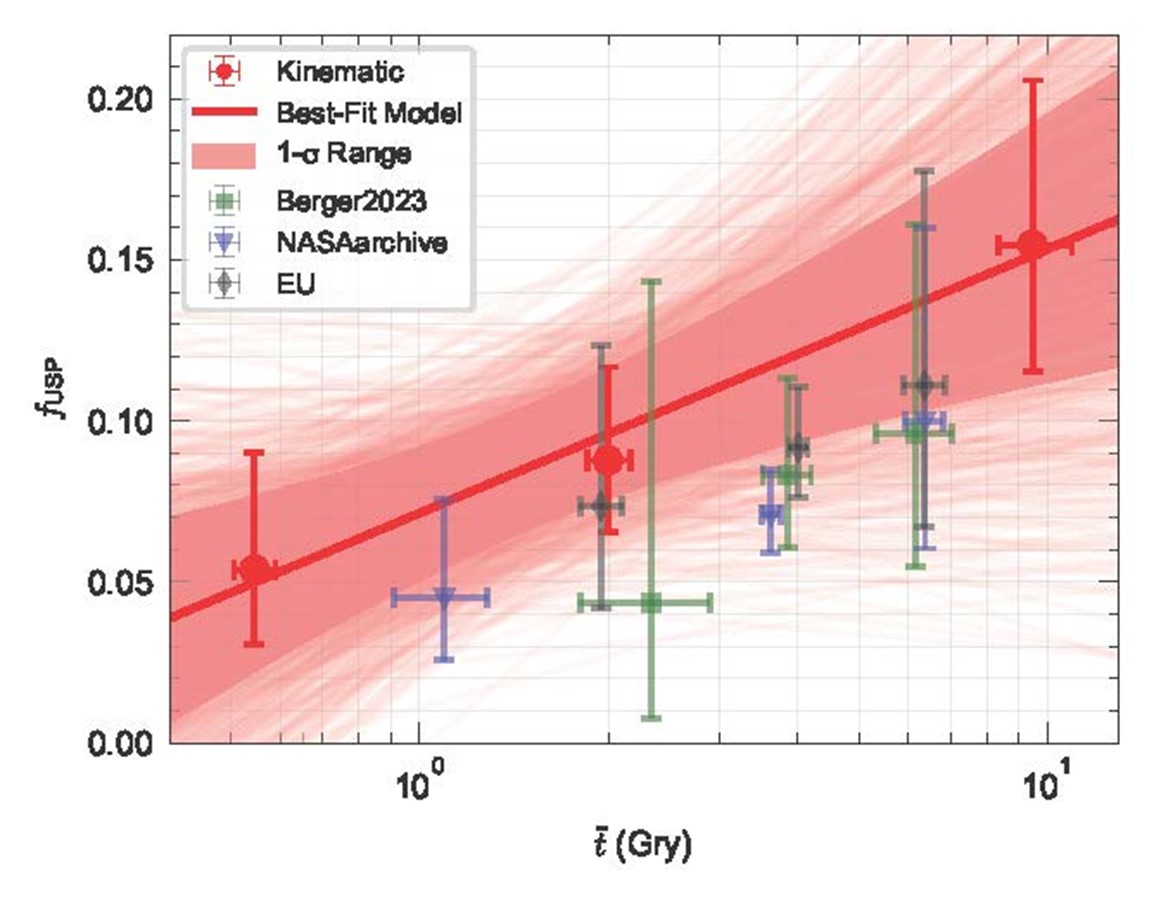
Figure 2: Evolution of the occurrence rate of Ultra-Short-Period planets with age.
The research team further analyzed the data and determined the evolution of the occurrence rate of USP planet systems with age, finding that the occurrence rate of USP planet systems increases with age (Figure 2). This discovery indicates that most USP planets likely formed billions of years later, making formation via very early models (like disk migration) unlikely to be the primary pathway.
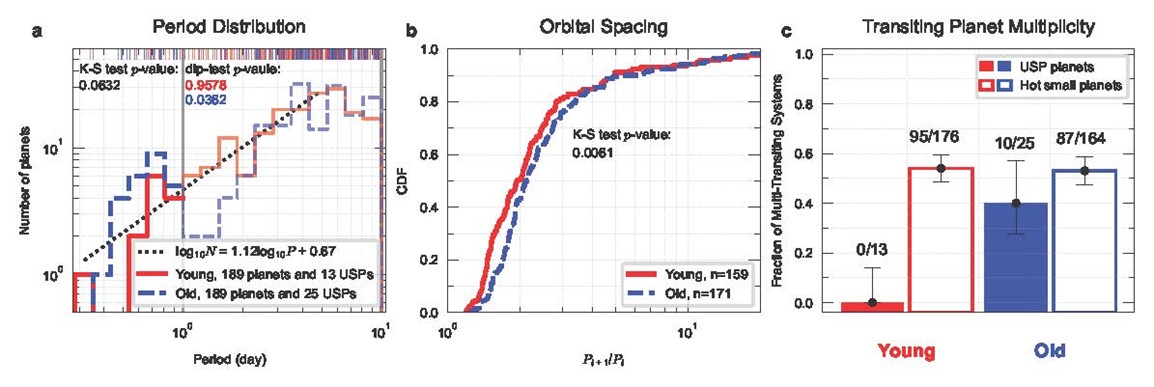
Figure 3: Comparison of orbital architectures between young and old Ultra-Short-Period planet systems and short-period low-mass planet systems. Left, middle, and right panels show the orbital period distribution, orbital spacing distribution, and the proportion of multi-transiting systems, respectively.
Furthermore, the research team revealed the evolution of the orbital architecture of USP planet systems with age: differences exist in the period distribution of the innermost planets between young and old short-period low-mass planet systems; the older subsample exhibits a "dip-pileup" feature around 1-2 days in orbital period (Figure 3a). Additionally, the older subsample generally has larger orbital spacings compared to the younger subsample (Figure 3b). Notably, among the young USP planet sample, the proportion of multi-transiting systems is lower (Figure 3c), suggesting that young USP planet systems may have higher mutual inclinations and/or fewer neighboring companion planets.
The age dependence of the occurrence rate and orbital architecture of USP planet systems described above indicates that USP planets continuously form over billions of years via orbital migration driven by tidal dissipation. Moreover, relatively young and relatively old USP planets originate from different tidal migration pathways (high-eccentricity migration and low-eccentricity migration, respectively). These findings outline an overall picture of the formation mechanism and tidal evolution of USP planets.
This paper is one of a series from the research plan "Planets Across Space and Time" (abbreviated as PAST in English and "穿越" in Chinese) initiated by Professor Xie Jiwei's research team. Currently, the number of discovered exoplanets has reached several thousand. Among these planets are "infant" planets only millions of years old, as well as "ancient" planets as old as the Milky Way itself, exceeding ten billion years in age. Their distances range from the solar neighborhood (within hundreds of light-years) to tens of thousands of light-years away, gradually populating all corners of the Milky Way (scale approximately one hundred thousand light-years). Targeting these planets that "traverse" space and time, the exoplanet research group at the School of Astronomy and Space Science, Nanjing University, is conducting a large-sample census study using China's Guo Shoujing Telescope (LAMOST). Analyzing the distribution characteristics of planets across different spatial locations in the Milky Way and at different ages will help further understand the processes of planet formation and evolution, as well as the connection between planet formation/evolution and the formation/evolution of the entire Milky Way. Currently, more follow-up work in the "PAST" series is underway and being prepared.
This research was supported by the National Key R&D Program of China, the National Natural Science Foundation of China, and the LAMOST Major Achievements Cultivation Project.
Paper link:
Tu, P.-W., Xie, J.-W., Chen, D.-C., Zhou, J.-L. Age dependence of the occurrence and architecture of ultra-short-period planet systems. Nat Astron (2025). https://www.nature.com/articles/s41550-025-02539-1