Based on observational data from the Gaia satellite and the Large Sky Area Multi-Object Fiber Spectroscopic Telescope (LAMOST), Chinese astronomers have discovered a star ejected from a globular cluster in the Milky Way, with a velocity as high as 550 kilometers per second. Their analysis suggests that such a high escape velocity is likely due to the presence of an intermediate-mass black hole at the center of the cluster. This discovery provides new evidence for the existence of intermediate-mass black holes. The relevant research findings were published as a cover article in National Science Review.
There are two known types of black holes in the universe: stellar-mass black holes formed from the collapse of massive stars, and supermassive black holes located at the centers of galaxies. However, intermediate-mass black holes, whose masses lie between the two, have never been definitively confirmed. They are supposed to be a necessary stage in the growth of stellar-mass black holes into supermassive black holes, yet astronomers have so far only found a few suspicious candidates.
Astronomers believe that globular clusters are the most likely birthplaces of intermediate-mass black holes. The densely packed stars at the centers of these clusters can undergo frequent collisions and mergers, forming intermediate-mass black holes. Twenty years ago, the Hubble Space Telescope observed that a black hole with a mass of 1,700–3,200 times that of the Sun might exist at the center of the globular cluster M15. However, after the result was published, many astronomers raised doubts, arguing that the observational data came from a region 5,200 astronomical units away from M15’s center—where thousands of dense stars might be gathered, rather than a single black hole.
In recent years, scientists have discovered seven high-velocity stars in another cluster, speculating that these stars might be related to an intermediate-mass black hole. However, they still lie over 1,000 astronomical units from the cluster center. “Therefore, how to find an effective method to detect intermediate-mass black holes as close as possible to the centers of globular clusters has become the final link in the chain of evidence confirming the existence of intermediate-mass black holes,” said Huang Yang, co-first author and corresponding author of the paper, and an associate professor at the National Astronomical Observatories of the Chinese Academy of Sciences / University of Chinese Academy of Sciences.
To solve this problem, the research team proposed that if an intermediate-mass black hole exists, its strong gravitational force would act like a slingshot during a close encounter with a nearby binary star system, ejecting one of the stars at high speed. Using data from the Gaia satellite and LAMOST, they screened nearly a thousand high-velocity stars and over a hundred globular clusters in the Milky Way, and unexpectedly discovered that the star designated J0731+3717 was ejected from globular cluster M15 at a speed of 550 kilometers per second about 20 million years ago.
Interestingly, the ejected star also carries chemical composition and age characteristics completely consistent with M15. Astronomers calculated that to accelerate the star to such a speed, an object with a mass equivalent to 2,000 times that of the Sun must have exerted gravitational force on it from just one astronomical unit away. “It is impossible for thousands of neutron stars or small black holes to crowd into this location; the only reasonable explanation is that an intermediate-mass black hole is lurking here,” said Huang Yang. “This discovery is like catching the ‘cosmic slingshooter’ in the act at the center of the cluster, completing the final link in the chain of evidence for the existence of intermediate-mass black holes.”
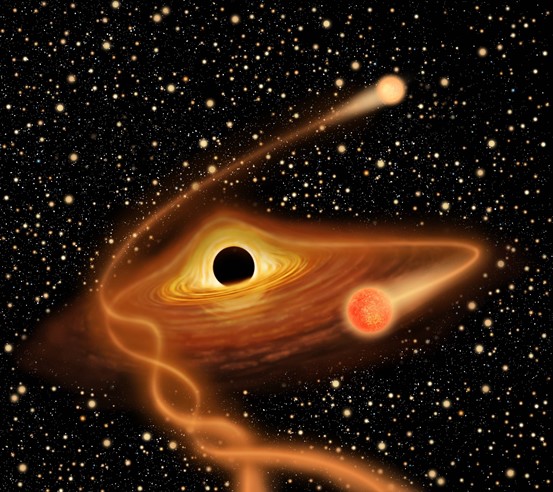
Figure 1, Artistic illustration of a star escaping from a globular cluster