Recently, the research team from the Joint Laboratory for High-Power Laser Physics at the Shanghai Institute of Optics and Fine Mechanics (SIOM) of the Chinese Academy of Sciences has made a significant breakthrough in the field of ultrafast spatiotemporal light field measurement.
The team developed a Spatiotemporal Wavefront Sensor (STWFS), achieving for the first time single-shot, self-referenced three-dimensional optical field characterization of spatiotemporal wave packets.
This provides a crucial diagnostic tool for research in fields such as ultrafast lasers and light-matter interactions.
Related research findings were published in Optica under the title of "Single-shot 3D characterization of spatiotemporal wave packets via a spatiotemporal wavefront sensor (STWFS)."
Achieving robust, single-shot three-dimensional spatiotemporal characterization of ultrashort pulses, especially for novel spatiotemporally structured light fields, has long been a common challenge and urgent need across multiple fields.
To address this bottleneck, the research team proposed a spatiotemporal wavefront sensing technology based on wavelength-division multiplexing. This technology utilizes a specially designed two-dimensional grating and narrow-bandpass filter to map light fields of different wavelengths to different spatial positions on the wavefront sensor. Combined with time-domain measurement equipment, this enables the complete three-dimensional optical field capture of a single laser pulse.
The method features high spatial and high spectral resolution, does not require an external reference beam, and entirely avoids measurement accuracy loss caused by information aliasing.
The research team constructed a compact prototype, which is reported to be the device with the best comprehensive performance for short-pulse spatiotemporal 3D light field measurement. It achieves 295×295 spatial sampling and 36-channel spectral sampling within a single frame, with a spectral resolution of 0.5 nm.
Validation experiments on pulse front tilt accuracy demonstrated that the absolute accuracy of spatiotemporal phase reconstruction reached 1.87 nm RMS (0.95%). Using the STWFS, the team achieved, for the first time, single-shot 3D optical field characterization of a spatiotemporal wave packet carrying transverse orbital angular momentum and obtained dynamic visualization of the focusing and propagation process of a spatiotemporal vortex pulse.
As a versatile spatiotemporal light field characterization method, STWFS can be applied to any type of ultrashort laser beam, and can provide three-dimensional spatiotemporal ultrafast diagnostics. It is expected to facilitate advancements in spatiotemporal photonics and enable broader applications in various fields such as laser processing, light-matter interactions, intense-field laser physics, and optical communications.
This work was supported by projects including the Chinese Academy of Sciences Strategic Priority Research Program, the National Natural Science Foundation of China, and the Shanghai High-Level Institutional Construction and Operation Program.
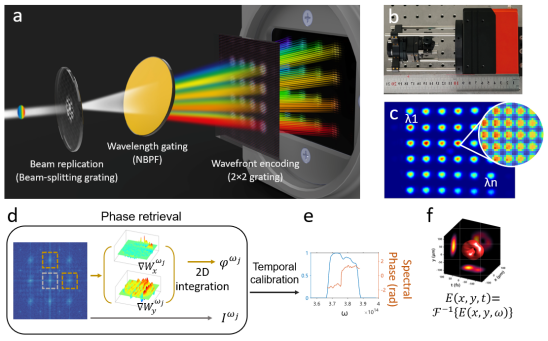
Fig. 1. Principle of the STWFS system
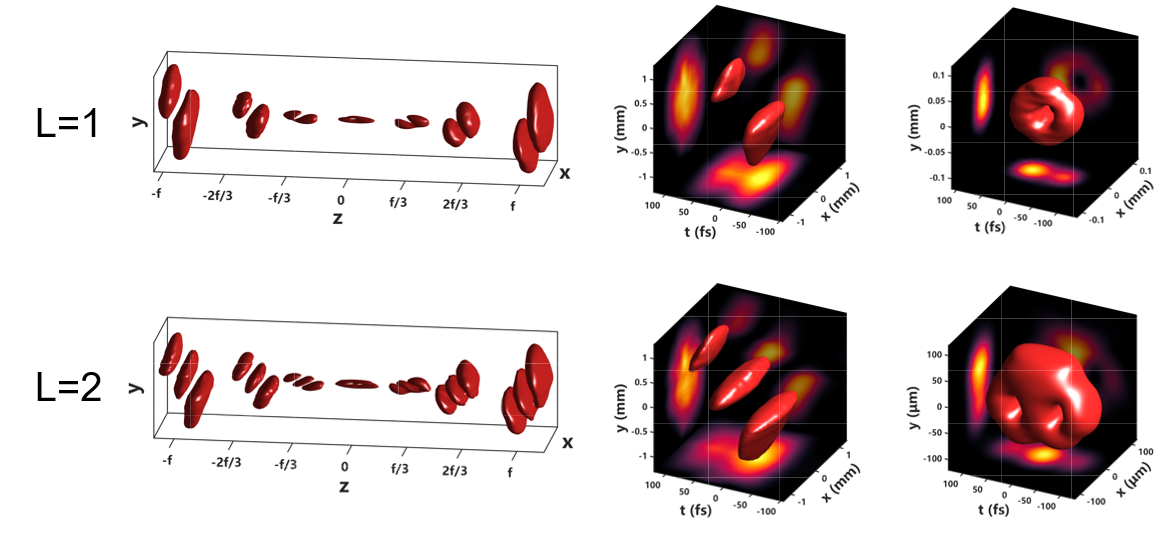
Fig.2. Measured and predicted 3D topological evolution of STOV during focusing with a spatiotemporal topological
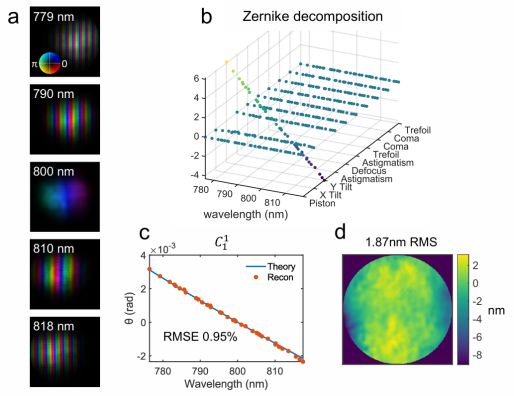
Fig. 3. Reconstruction of the angular dispersion