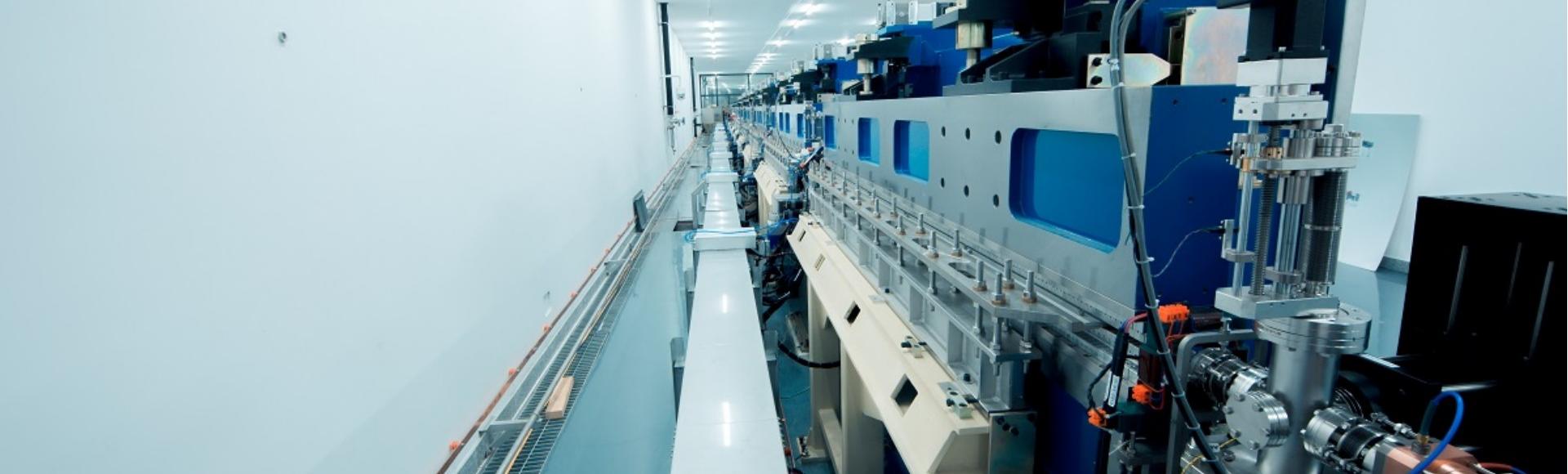
Recently, the Cluster Spectroscopy and Dynamics Research Group (Group 2506) of Dalian Light Source Research Laboratory, led by Researcher Jiang Ling and Associate Researcher Li Gang, in collaboration with Professor Li Jun's team from Tsinghua University and Professor Wang Laisheng's team from Brown University in the United States, utilized their independently developed neutral cluster experimental station based on Dalian Coherent Light Source. In the study of the photoionization efficiency spectroscopy of boron clusters, it was found that the smallest three-dimensional neutral boron cluster is composed of 9 boron atoms, providing a new idea for the systematic study of the structural evolution mechanism of neutral boron-based nanoclusters.
Boron has complex and diverse chemical properties due to its electron-deficient nature and has important applications in many fields such as materials, catalysis and energy. Over the past two decades, researchers have conducted extensive experimental studies on charged ionic boron clusters. Compared with ionic boron clusters, neutral boron clusters, due to the lack of charge, are difficult to detect and select in terms of mass, making experimental research more challenging. Therefore, achieving the spectral characterization of neutral boron clusters has long been one of the goals of researchers.

To achieve precise detection and structural analysis of neutral clusters, the team led by Jiang Ling and Li Gang has independently developed a neutral cluster experimental station based on the Dalian Coherent Light Source in recent years (Review of Scientific Instruments, 2020). The high-sensitivity spectroscopic detection, structural characterization and reaction performance research of mass-selective neutral clusters were achieved, and it was discovered that the three-dimensional structure of the smallest water droplet is composed of five water molecule clusters (Proc. NAT L. Acad. Sci., 2020). This unique experimental method has opened up a new way for the study of various neutral clusters.
In this work, Jiang Ling and Li Gang's team collaborated with Wang Laisheng's team to determine the photoionization efficiency spectra of a series of neutral boron clusters using the Neutral cluster experimental station based on the Dalian Coherent Light Source. The experimental results show that the first and second ionization potentials (IP1 and IP2) of B9 are 8.45±0.02eV and 9.61±0.02eV, respectively. Li Jun's team used a self-developed TGMin program combined with high-precision quantum chemistry theoretical methods to calculate various stable structures and ionization potentials of boron clusters. The theoretical results were highly consistent with the experimental results. Studies have shown that the most stable structure of B9 is the heptagonal bipyramidal configuration with D7h symmetry, indicating that a three-dimensional structure has been formed in the neutral B9 cluster, which is completely different from the planar molecular wheel structure of the B9-negative ion boron cluster. Bonding analysis indicates that in the neutral B9 cluster, the B-B single-electron bond between the cap B atoms is crucial for stabilizing the heptagonal bipyramidal structure of B9. This work reveals that the three-dimensional structure of the smallest neutral boron cluster is composed of nine boron atoms, breaking through the long-standing research bottleneck of researchers on neutral boron clusters and providing a new possibility for revealing the structural evolution mystery of boron-based nanoclusters.
the relevant research results are titled "Observation of the Smallest Three-Dimensional Neutral Boron Cluster". Published in Angewandte Chemie International Edition. The co-first authors of this work are Xu Congqiao, an associate professor at Southern University of Science and Technology, and Wang Tiantong, a doctoral student in Group 2506 of Dalian Institute of Chemical Physics. This work was supported by the Major Project of Science and Technology Innovation 2030 of the Ministry of Science and Technology, the National Natural Science Foundation of China, the Basic Science Center Project of "Frontier Research in Dynamic Chemistry" of the National Natural Science Foundation of China, and other projects. (Written and photographed by Xu Congqiao and Wang Tiantong
The article links: https://doi.org/10.1002/anie.202419089
(The text and images are reprinted from the homepage of Dalian Institute of Chemical Physics, Chinese Academy of Sciences)
