
The discovery of quantum materials with kagome lattices has garnered significant attention due to their unique band structures, including flat bands, Dirac points, and van Hove singularities. Recently, vanadium-based kagome metals AV3Sb5 (A = K, Rb, Cs) have been synthesized experimentally, exhibiting rich physical phenomena such as superconductivity, chiral charge order, pairing density waves, and anomalous Hall effects. These discoveries have attracted extensive research and become a frontier hotspot in the field of condensed matter physics. In the exploration of kagome lattice quantum materials with the same structure as AV3Sb5, the team led by Guanghan Cao at Zhejiang University, after conducting numerous experiments, was the first to prepare a new chromium-based kagome structured CsCr3Sb5 single crystal. Through detailed measurements of resistivity, magnetic susceptibility, specific heat, and low-temperature crystal structure, they found that it undergoes long-range antiferromagnetic order at TN≈55K accompanied by the formation of charge density waves, with its electrical transport exhibiting "bad metal" characteristics. Compared to AV3Sb5, the electronic correlations in CsCr3Sb5 are significantly enhanced, providing a novel material platform for studying strong correlation physics in kagome lattices. The magnetic ordering form at ambient pressure and the possibility of achieving unconventional superconductivity through pressure-driven magnetic quantum critical points have become the most focused issues. However, due to the extremely thin, fragile, and low-yield nature of CsCr3Sb5 single crystal samples, it is experimentally challenging to determine the magnetic ordering at ambient pressure and accurately measure the evolution of physical properties under high pressure. Ultimately, Cao's team collaborated with the teams led by Jin Guang Cheng and Rui Zhou from the Institute of Physics, Chinese Academy of Sciences/National Research Center for Condensed Matter Physics, and successfully overcame these challenges with the help of the unique experimental techniques of the Synergetic Extreme Condition User Facility (SECUF). They were the first to observe unconventional superconductivity near the pressure-driven magnetic quantum critical point, contributing to the discovery of the new kagome chromium-based superconductor.
Since the total mass of CsCr3Sb5 single crystals is less than 0.1 mg,conventional spectroscopic measurements are difficult to characterize its magnetic ordering properties at ambient pressure. Shen Qinxin, Luo Jun, Yang Jie, and Zhou Rui from the HX-02 group at the Huairou Research Department of the Institute of Physics, using the high-field nuclear magnetic resonance system provided by the SECUF-A6 experimental station, conducted long-term 123Sb nuclear magnetic resonance spectrum measurements under a strong magnetic field of 25 T. As shown in Figure 1, they found that the spectral weight decreases sharply with decreasing temperature below TN≈55 K, indicating a significant change in the spectral shape, and possibly a decrease in the spin-spin relaxation time due to magnetic fluctuations, which are typical characteristics of a magnetic phase transition. Additionally, the 123Sb nuclear magnetic resonance spectrum splits into two very broad peaks at low temperatures, directly providing spectroscopic evidence for the existence of antiferromagnetic order. These results demonstrate that CsCr3Sb5 is a strongly correlated metal system with long-range antiferromagnetic order. Compared to conventional nuclear magnetic resonance measurement systems, the 25 T strong magnetic field at the A6 experimental station can improve measurement efficiency by more than 10 times, playing a crucial role in successfully measuring such a small amount of single crystal samples.
Due to the thickness of CsCr3Sb5 single crystals being only ~20μm and their fragility, high-pressure physical property testing is very challenging. Liu Ziyi, Yang Pengtao, Wang Bosen, and Cheng Jin Guang from the HX-EX6 group at the Huairou Research Department of the Institute of Physics, using the large-volume anvil high-pressure low-temperature physical property measurement system provided by the SECUF-A2 experimental station, leveraged its advantages of large sample space and good hydrostatic pressure to conduct detailed measurements of the resistivity and alternating current magnetic susceptibility of CsCr3Sb5 single crystals within the range of 0-12 GPa. This allowed for precise tracking of the evolution of antiferromagnetic order and superconductivity with pressure. As shown in Figure 2, as the pressure (P) increases, the single antiferromagnetic order (TN) at ambient pressure gradually evolves into two continuous transitions (T1 and T2), exhibiting characteristics of density wave transitions under pressure and gradually being suppressed by pressure. When P increases to ~3.65 GPa, coexistence of superconducting and density wave states is observed at low temperatures;while within the range of 4 to 8 GPa, the electrical transport properties exhibit clear "zero resistance" superconducting characteristics. High-pressure alternating current magnetic susceptibility measurements show a clear diamagnetic signal, confirming that the superconducting state under pressure is intrinsic bulk superconductivity. Based on these high-pressure measurement results, a temperature-pressure phase diagram for CsCr3Sb5 single crystals can be plotted. As shown in Figure 2d, CsCr3Sb5 exhibits an arched superconducting phase diagram within the pressure range of 3.65 to 8 GPa. At the critical pressure Pc≈4.2 GPa where magnetic order disappears, the superconducting transition temperature reaches a maximum of Tc~6.4 K, and the upper critical field μ0Hc2(0) also reaches a maximum of 14.34 T, exceeding the Pauli paramagnetic limit μ0Hp=1.84Tc=11.78T. Superconductivity disappears when the pressure exceeds 10GPa. Analysis of the resistivity data shows that the normal state near Pc exhibits non-Fermi liquid behavior and quantum critical characteristics of divergent electron effective mass, which are very similar to the phase diagrams of unconventional superconductors such as iron-based, CrAs, and MnP. This suggests that the pressure-induced superconducting state in CsCr3Sb5 is likely to have an unconventional pairing mechanism.
The relevant results were publishedin Nature on August 28 with the title "Superconductivity under pressure in a chromium-based kagome metal," at https://www.nature.com/articles/s41586-024-07761-x. Dr. Liu Yi from Zhejiang University, Associate Researcher Liu Ziyi from the Institute of Physics (Superconducting Key Laboratory SC4 group), and Associate Professor Jinke Bao from Hangzhou Normal University are the co-first authors of the paper. Professors Guanghan Cao from Zhejiang University, Jin Guang Cheng and Rui Zhou from the Institute of Physics are the co-corresponding authors. Additionally, Associate Researcher Bosen Wang and Deputy Engineer Pengtao Yang from the SECUF-A2 (anvil high-pressure experimental station), Associate Researchers Jie Yang, Jun Luo, and doctoral candidate Qinxin Shen from the SECUF-A6 (high-field nuclear magnetic resonance experimental station) participated in this work. The project was supported by the National Key Research and Development Program of China, the National Natural Science Foundation of China, the Chinese Academy of Sciences' Class B Pilot Program, and the Youth Innovation Promotion Association of the Chinese Academy of Sciences. The high-field full superconducting magnet at the SECUF-A6 experimental station was jointly developed by the team led by Academician Qiuliang Wang from the Institute of Electrical Engineering of the Chinese Academy of Sciences.
SECUF is a major national science and technology infrastructure during the "12th Five-Year Plan" period. It has been built into an internationally advanced user experimental facility integrating extreme conditions such as extremely low temperatures, ultra-high pressures, strong magnetic fields, and ultrafast optical fields. It can greatly enhance China's comprehensive strength in basic and applied basic research in the field of material science and related fields. SECUF began construction in 2017, was fully commissioned in early 2023, and its 20 experimental stations are open to domestic and foreign users. The solicitation and review of SECUF projects are conducted through the Chinese Academy of Sciences' Major Science and Technology Infrastructure Sharing Service Platform (https://lssf.cas.cn), with two rounds of centralized solicitation for user projects opening in March and September each year.
[1] Y. Liu,Z. Y. Liu,J. K. Bao,P. T. Yang,L. W. Ji,S. Q. Wu,Q. X. Shen,J. Luo,J. Yang,J. Y. Liu,C. C. Xu,W. Z. Yang,W. L. Chai,J. Y. Lu,C. C. Liu,B. S. Wang,H. Jiang,Q. Tao,Z. Ren,X. F. Xu,C. Cao,Z. A. Xu,R. Zhou,J.-G. Cheng,G.-H. Cao,"Superconductivity under pressure in a chromium-based kagome metal";Nature (2024),https://www.nature.com/articles/s41586-024-07761-x.
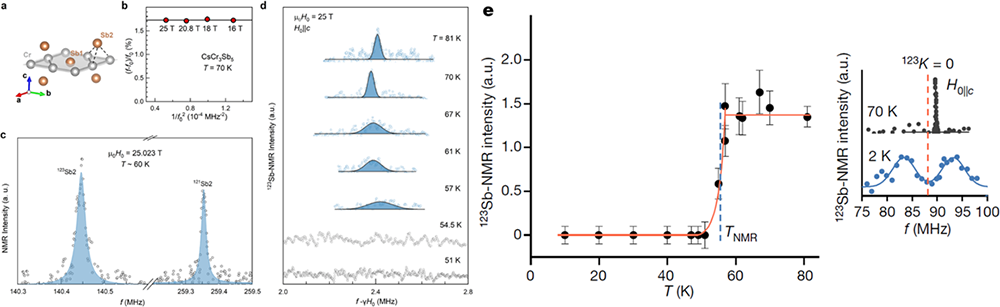
Figure 1. High-field NMR measurement results of CsCr3Sb5 single crystals and confirmation of antiferromagnetic ordering.
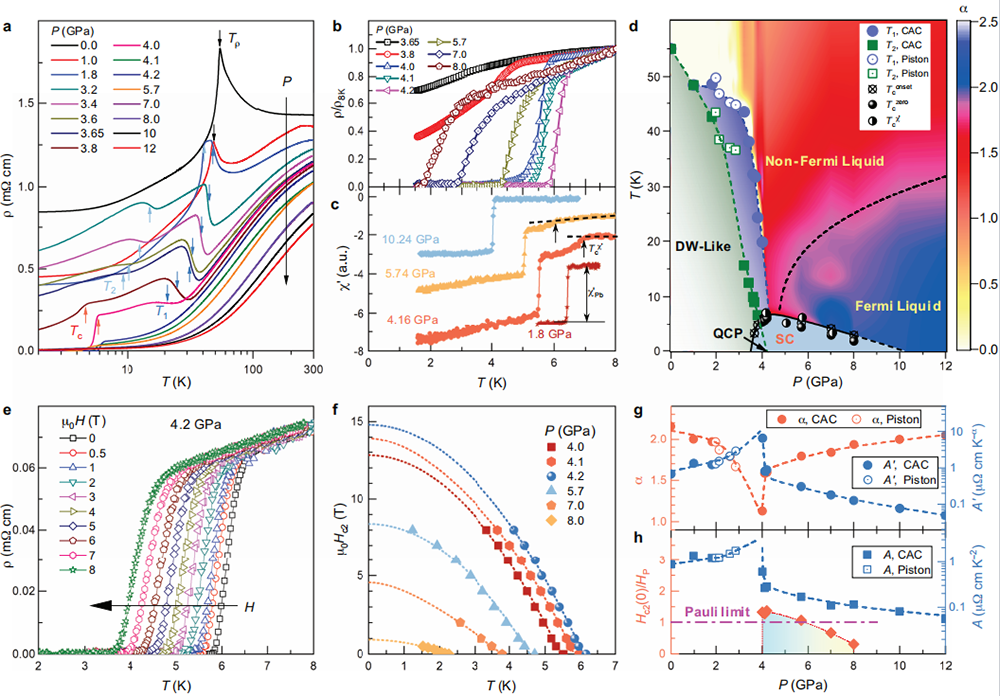
Figure 2. Pressure-induced unconventional superconductivity in CsCr3Sb5.


