Log in Sign up 中文
English
  • Home
  • About
  • Facilities
    • Material
    • Earth System and Environment
    • Engineering Technology
    • Space and Astronomy
    • Particle and Nuclear Physics
    • Energy
    • Biology
  • News
    • News & Updates
    • Research Highlights
  • Notice
  • User Portal
  • Home
  • Facilities
    • Material
    • Earth System and Environment
    • Engineering Technology
    • Space and Astronomy
    • Particle and Nuclear Physics
    • Energy
    • Biology
  • News
    • News & Updates
    • Research Highlights
  • Notice
  • User Portal

Beijing Electron Positron Collider (BEPCII)

  1. Home>Facilities>Particle and Nuclear Physics>Beijing Electron Positron Collider (BEPCII)>News
  • News
  • Notice
  • Equipment
  • Contact
  • Data Resource
News
  • Chinese Scientists Set World Record for Solar Cell Efficiency
    Chinese Scientists Set World Record for Solar Cell Efficiency
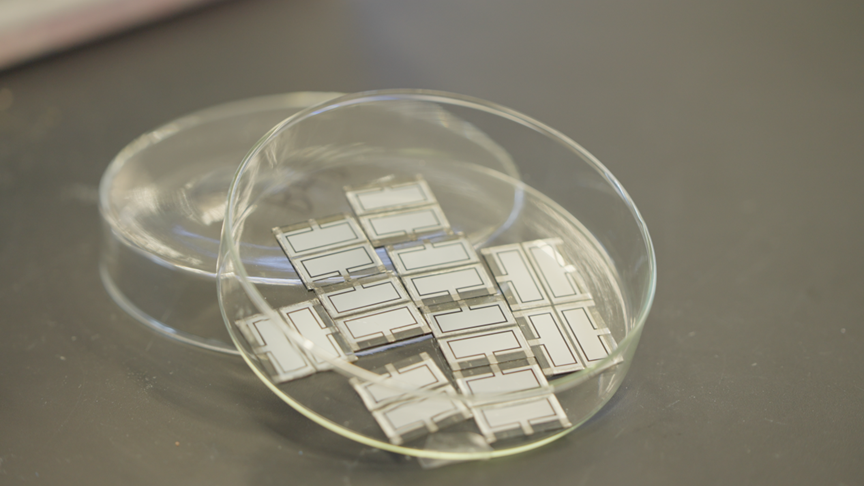
    Researchers achieved a certified steady-state power conversion efficiency of 28.04 percent using a perovskite-organic tandem solar cell. This tandem architecture integrates two complementary light-absorbing subcells to harvest a broader range of the solar spectrum than traditional single-layer devices.
    Chinese scientists develop new perovskite-organic tandem solar cells. [Provided to chinadaily.com.cn]Chinese scientists have set a new world record for next-generation solar cells, bringing lightweight, flexible and highly efficient solar power closer to everyday use on everything from wearable devices to space stations.The researchers achieved a certified steady-state power conversion efficien...
    Jul 31, 2026
  • BESIII Experiment Observes Threshold Enhancement Effect in Dipion System
    BESIII Experiment Observes Threshold Enhancement Effect in Dipion System
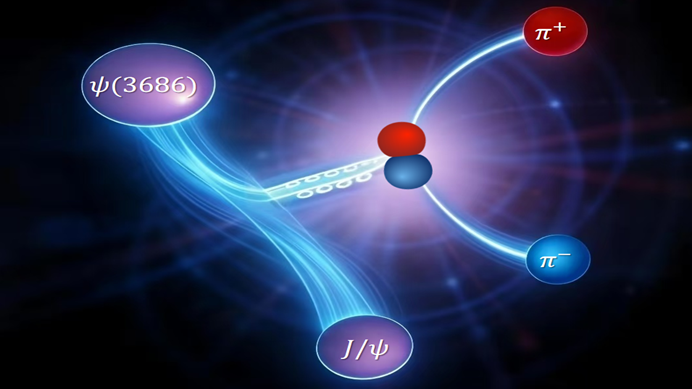
    The BESIII international collaboration experiment achieved a major breakthrough in charmonium decay research. The research team led by the Institute of High Energy Physics of the Chinese Academy of Sciences, for the first time, observed a distinct "resonance-like" structure at the dipion mass threshold.
    The BESIII international collaboration experiment achieved a major breakthrough in charmonium decay research. The research team led by the Institute of High Energy Physics (IHEP) of the Chinese Academy of Sciences, for the first time, observed a distinct "resonance-like" structure at the dipion mass threshold. The study was published in Physical Review Letters on April 8.Charmonium, a bound sta...
    Apr 22, 2026
  • Observation of New Radiative Decays of Excited Hyperons Λ(1520)/Λ(1690) at BESIII
    Observation of New Radiative Decays of Excited Hyperons Λ(1520)/Λ(1690) at BESIII
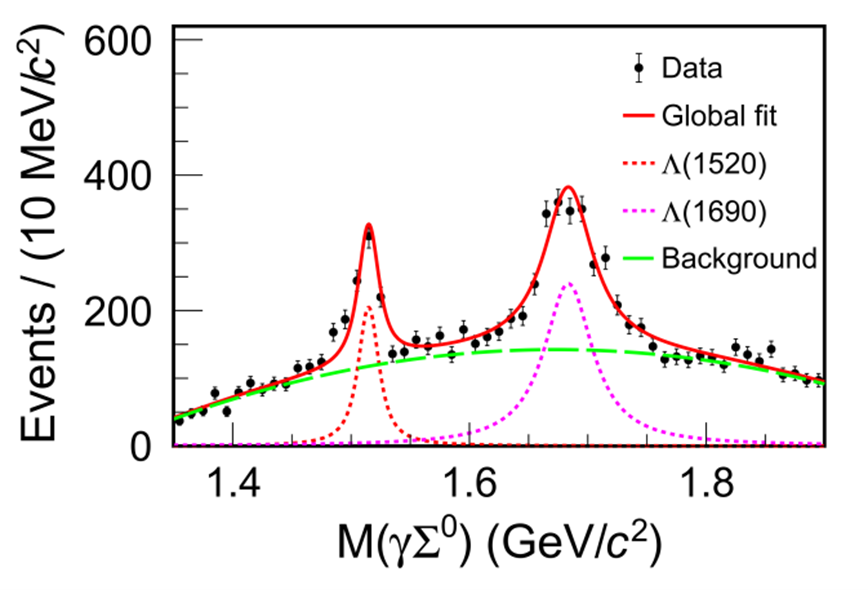
    The BESIII Collaboration led by the Institute of High Energy Physics of the Chinese Academy of Sciences achieved a significant breakthrough in the study of electromagnetic radiative decays of excited hyperons. The researchers observed, for the first time, the radiative decays of the excited states Λ(1520) and Λ(1690) into a photon (γ) and a Σ⁰ particle.
    The Λ hyperon is a baryon containing a strange quark, and its excited states, Λ(1520) and Λ(1690), provide opportunities for probing the strong interaction and understanding quark confinement. Electromagnetic radiative decay processes in which a single photon is emitted, act much like an "electromagnetic CT scan" of the particle and serve as a unique probe of its internal structure. However,...
    Apr 22, 2026
  • Observation of charmonium hc radiative decays to multiple light hadrons and the tensor state f2 (1270)
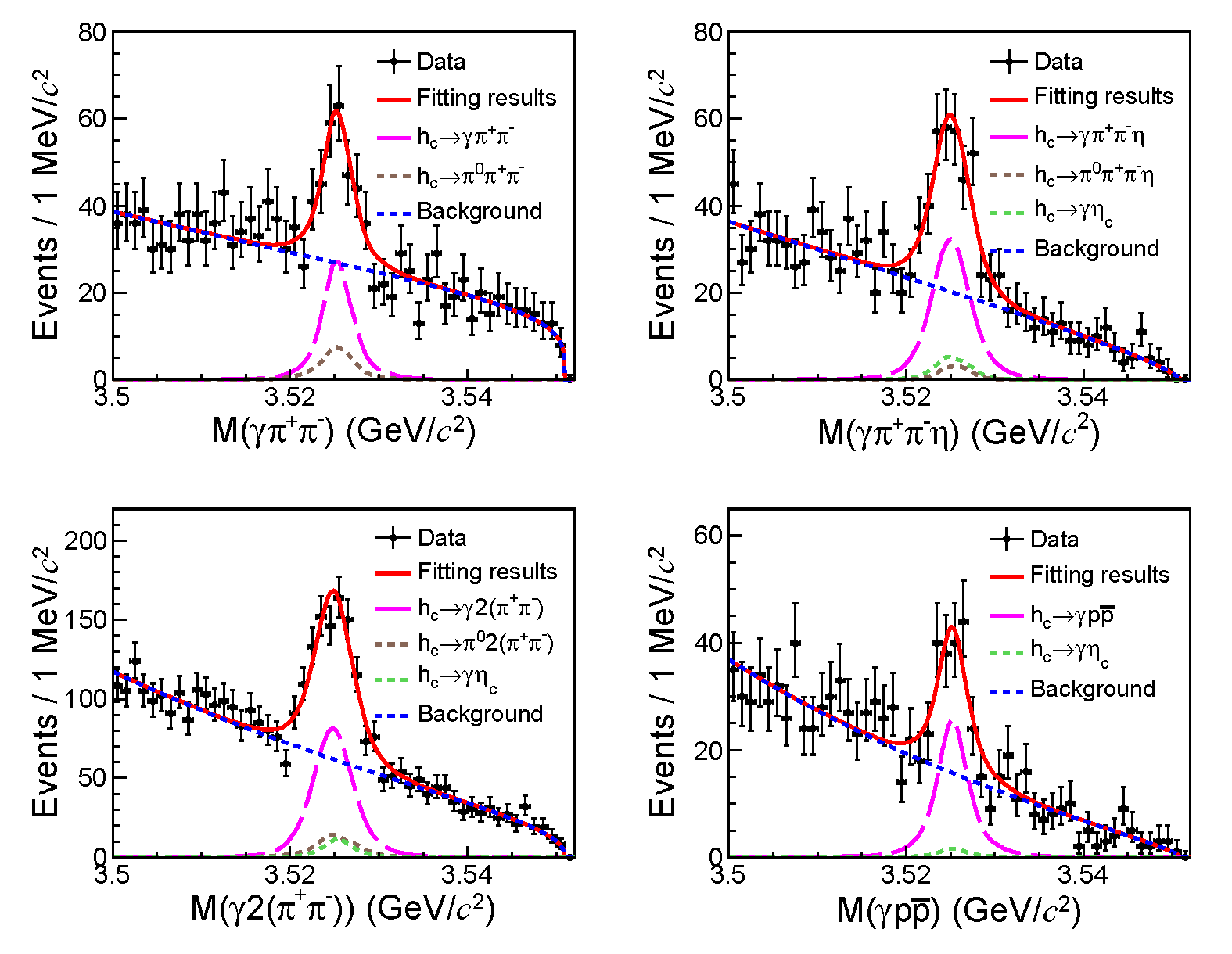
    Observation of charmonium hc radiative decays to multiple light hadrons and the tensor state f2 (1270)
    The BESIII Collaboration recently reported “Observation of charmonium hc radiative decays to multiple light hadrons and the tensor state f2 (1270)”.
    The BESIII Collaboration recently reported “Observation of charmonium hc radiative decays to multiple light hadrons and the tensor state f2 (1270)”. The paper has been published online in Physical Review Letter on June. 17, 2025. [Phys. Rev. Lett. 134, 241902 (2025)].The study of charmonium radiative decay provides a unique opportunity to deepen our understanding of quantum chromodynamics (...
    Jun 18, 2025
  • Test of Local Realism via Entangled ΛΛ System
    Test of Local Realism via Entangled ΛΛ System
    The BESIII Collaboration has achieved a landmark violation of Bell inequalities using entangled hyperon pairs,marking a pivotal test of quantum nonlocality in high-energy physics.
    The BESIII Collaboration has achieved a landmark violation of Bell inequalities using entangled hyperon pairs,marking a pivotal test of quantum nonlocality in high-energy physics. Published in Nature Communications (Nat. Commun.,16,4948 (2025)),the study uses (10.087 ± 0.044) × 10⁹ J/ψ events accumulated at BEPCII/BESIII to probe the ΛΛ entangled system produced in J/ψ→ γηc ,   and...
    Jun 04, 2025
  • Observation of new modes of Ds decay into Vector-Vector final states
    Observation of new modes of Ds decay into Vector-Vector final states
    The BESIII collaboration recently reported the observation of the W-Annihilation Process Ds+→ωρ+ and the measurement of Ds+→ϕρ+.
    The BESIII collaboration recently reported the observation of the W-Annihilation Process Ds+→ωρ+ and the measurement of Ds+→ϕρ+. The results have been published in Physics Review Letters on May 22, 2025 [PhysRevLett.134.201902].The polarization information of heavy-flavor mesons decaying into two vector particles(V) has attracted the attention of physicists for decades because of its uni...
    May 26, 2025
  • Observation of the Charmonium Decay ηc→γγ in J/ψ→γηc
    Observation of the Charmonium Decay ηc→γγ in J/ψ→γηc
    The BESIII Collaboration recently reported “Observation of the charmonium decay ηc→γγ in J/ψ→γηc”.
    The BESIII Collaboration recently reported “Observation of the charmonium decay ηc→γγ in J/ψ→γηc”. The paper has been published online in Physical Review Letters [Phys. Rev. Lett. 134, 181901 (2025)].The charmonium system serves as a golden probe for investigating the nature of quantum chromodynamics (QCD), which is the fundamental theory governing strong interactions. The decay rate ...
    May 16, 2025
  • Observation of an axial-vector state in the decay ψ(3686)→ϕηη'
    Observation of an axial-vector state in the decay ψ(3686)→ϕηη'
    The BESIII Collaboration recently reported “Observation of an axial-vector state in the study of the decay ψ(3686)→ϕηη'  ”
    The BESIII Collaboration recently reported “Observation of an axial-vector state in the study of the decay ψ(3686)→ϕηη'  ”. The paper has been published online in Physical Review Letter. [Phys. Rev. Lett. 134, 191901 (2025)].A strangeonium state, being the bound state of a light s and anti-s quark, is related to color confinement in strong interactions, which provides insights into non-...
    May 15, 2025
  • The X(2370) paper from the BESIII experiment was selected into PRL Collection of the most important papers in 2024
    The X(2370) paper from the BESIII experiment was selected into PRL Collection of the most important papers in 2024
    The X(2370) paper from the BESIII experiment was selected into PRL Collection of the most important papers in 2024.
    In 2024, the Spin-Parity quantum numbers of the X(2370) particle was determined to be 0-+ for the first time by the BESIII collaboration and its mass is found to be consistent with the theoretically predicted mass of the lightest pseudoscalar glueball. This important experimental measurement supports the interpretation of the X(2370) as the lightest pseudoscalar glueball and it was published i...
    Apr 24, 2025
  • Evidence for Two Excited Ω- Hyperons
    Evidence for Two Excited Ω- Hyperons
    The BESIII collaboration recently reported the evidence for two excited Ω- hyperons.
    The BESIII collaboration recently reported the evidence for two excited Ω- hyperons. The results have been published in Physics Review Letters on March 4, 2025 [Phys. Rev. Lett. 134, 131903 (2025)].Baryons are the simplest system in which all three colors of QCD form a colorless object. Understanding their structure and spectroscopy is a necessary component of a real understanding of QCD. How...
    Apr 08, 2025
12NEXT
MORE

Copyright © 2002 - Chinese Academy of Sciences

Address: No.52 Sanlihe Road, Beijing ,100864