Log in Sign up 中文
English
  • Home
  • About
  • Facilities
    • Material
    • Earth System and Environment
    • Engineering Technology
    • Space and Astronomy
    • Particle and Nuclear Physics
    • Energy
    • Biology
  • News
    • News & Updates
    • Research Highlights
  • Notice
  • User Portal
  • Home
  • Facilities
    • Material
    • Earth System and Environment
    • Engineering Technology
    • Space and Astronomy
    • Particle and Nuclear Physics
    • Energy
    • Biology
  • News
    • News & Updates
    • Research Highlights
  • Notice
  • User Portal

Five-hundred-meter Aperture Spherical radio Telescope (FAST)

  1. Home>Facilities>Space and Astronomy>Five-hundred-meter Aperture Spherical radio Telescope (FAST)>News
  • News
  • Notice
  • Equipment
  • Contact
  • Data Resource
News
  • FAST Discovers Largest Atomic Gas Structure Around a Galaxy Group
    FAST Discovers Largest Atomic Gas Structure Around a Galaxy Group
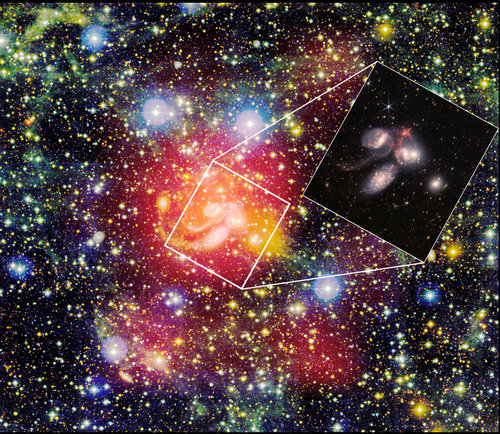
    The research team make an imaging study of the famous compact galaxy group "Stephen Quintuple" and the hydrogen atom gas in the surrounding sky area using FAST. They found a huge atomic gas system with a scale of about 2 million light-years, 20 times larger than our Milky Way. This is the largest atomic gas system detected in the universe so far. FAST's high sensitivity brings unprecedented ability to detect extremely dim object. The result was published in Nature on October 19.
    Atomic gas is  the basic material that all galaxies are formed from. The evolution of  galaxies is mostly a procedure of accreting atomic gas from the  intergalactic medium and then converting it into stars.For  this reason, observation and exploration of atomic gas in and around  galaxies is crucial to the study of galaxy formation and evolution  models. The most direct method of e...
    Oct 21, 2022
  • FAST Reveals Dynamically Evolving Environment Around a Repeating Fast Radio Burst Source
    FAST Reveals Dynamically Evolving Environment Around a Repeating Fast Radio Burst Source
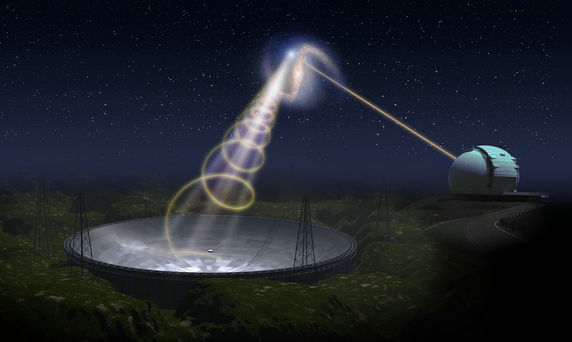
    The research team carried out deep observations toward FRB 20201124A using FAST telescope. They got the largest polarization sample of FRBs so far. For the first time, they detected the magnetic field changes in the surrounding environment only one astronomical unit (the distance from the sun to the earth) from the center of the FRB. This is a key step to understand the central engine mechanism of fast radio bursts. The results were published in Nature on September 21.
     Image: Artist’s Illustration of FAST and Keck observation. (Credit: Jingchuan Yu and Hai Fu.)Fast radio bursts (FRBs) are highly dispersed millisecond-duration radio bursts. They are extremely powerful - comparable to the amount of energy modern human civilization could produce over tens of billions of years. Since the discovery of the first FRB in 2007, several hundred of them had been foun...
    Sep 29, 2022
  • CRAFTS Discovers Younger and Weirder Brother of First Repeating Fast Radio Burst
    CRAFTS Discovers Younger and Weirder Brother of First Repeating Fast Radio Burst
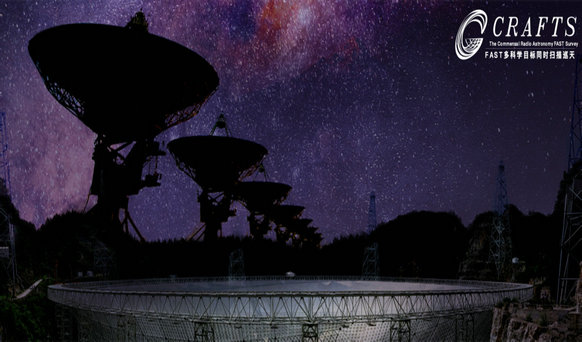
    The research team have found the only case of continuously active repetitive FRB 20190520B so far. It’s supported by FAST 's priority and key science project of Commensal Radio Astronomy FAST Survey (CRAFTS). After that, the team integrated the data of radio interference array, optical, infrared telescope and space high-energy observatory by organizing a number of international equipment to observe jointly. It is found that FRB20190520B is located in a metal-poor dwarf galaxy 3 billion light-years away from us. It is confirmed that the near-source region has the largest known electron density, and the second FRB persistent radio source (PRS) has been found so far. These findings reveal that the complex environment around actively repeating bursts has similar characteristics with the explosion of super bright supernovae. It challenges the traditional view of FRBs dispersion analysis. It lays a foundation for building the evolution model of FRB and understanding this intense cosmic mysterious phenomenon. The results were published in Nature on June 9. This achievement was selected as the "Top Ten Domestic Science and Technology News in 2022" and the "Top 10 International Science and Technology News in 2022" of China Media Group ( CCTV).
    Fast radio bursts (FRBs) are the brightest radio transients in the Universe. Little is known about the intrinsic characteristics. Even the most simple, descriptive questions, such as "Do all FRBs repeat?" remain unanswered.So far, less than 5% of all the hundreds of FRBs have been seen to repeat. Only a few are persistently active, providing precious glances into their secrets.Now, an internati...
    May 31, 2022
  • Frequency-dependent Polarization of Repeating Fast Radio Bursts Reveals Their Origin
    Frequency-dependent Polarization of Repeating Fast Radio Bursts Reveals Their Origin
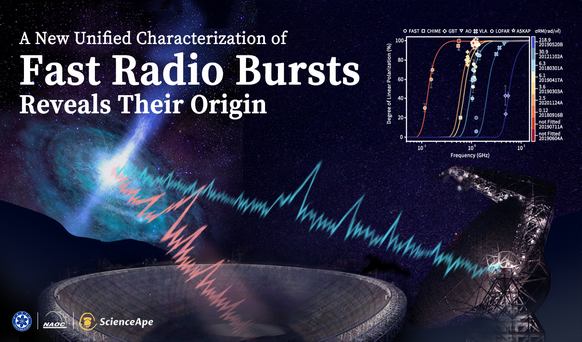
    The research team analyzed the observational data of FAST and GBT (the Green Bank Telescope). A mechanism that can uniformly explain the polarization frequency evolution of repeating FRB is proposed for the first time. Based on this, a single parameter, "RM dispersion", which can describe the surrounding environment of the FRBs is derived. This mechanism supports the repeating FRB in a complex ionizing environment which is similar to supernova remnants. The possible evolution stage of FRBs is determined by polarization observation, which provides key observational evidence for the origin of the FRBs. The greater the "RM dispersion" of the FRB, the more change of its surrounding environment. Therefore, it is also likely to be younger, which has the potential to become an "ID card" to identify repeating bursts. The results were published in Science on March 18.
    A new unified characterization of FRB reveals their origin (Image by CAS/NAOC/ScienceApe)Fast radio bursts (FRBs) are the brightest millisecond-duration astronomical transients in radio bands with yet unknown origin.The polarization of FRBs contains crucial information about their environments. High-fidelity polarization measurements of FRBs are thus crucial to understanding their origin.A rese...
    Mar 17, 2022
  • FAST Detects Coherent Interstellar Magnetic Field with a Technique Conceived at Arecibo
    FAST Detects Coherent Interstellar Magnetic Field with a Technique Conceived at Arecibo
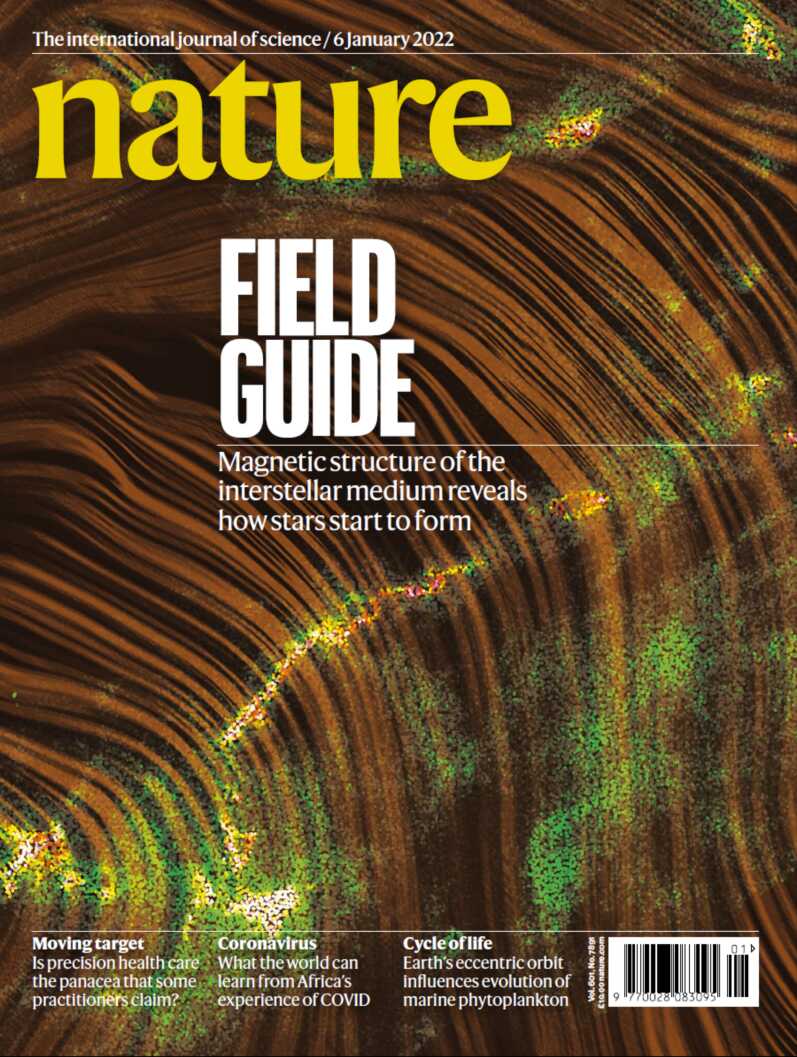
    Neutral hydrogen is the most abundant element in the universe. It widely exists in different periods of the universe and is one of the best tracers for the distribution of matter at different scales. The research team adopted the original neutral hydrogen narrow line self-absorption method. For the first time, they obtained the high confidence Zeeman effect measurements from a proto-star envelope. They found that the interstellar medium has a coherent magnetic field structure from cold neutral gas to proto-star. It is different from the prediction of standard model. It provides important observational evidence for solving the "magnetic flux problem", one of the three classic problems of star formation. This achievement was published in the form of a cover article in Nature on January 6.
    Magnetic fields are the essential, but often "secret" ingredients of the interstellar medium and the process of making stars. The secrecy shrouding interstellar magnetic fields can be attributed to the lack of experimental probes.While Michael Faraday was already probing the link between magnetism and electricity with coils in the early 19th century in the basement of the Royal Institution, ast...
    Nov 30, 2021
  • Over A Thousand Cosmic Explosions in 47 days Detected by FAST
    Over A Thousand Cosmic Explosions in 47 days Detected by FAST
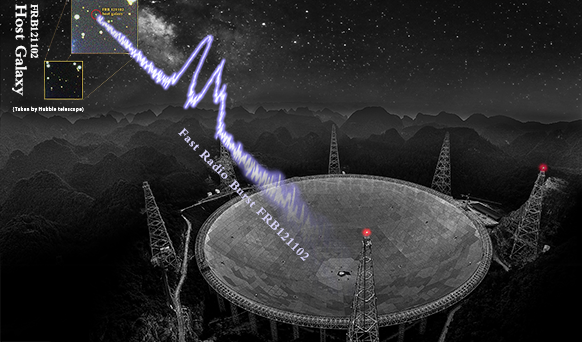
    Fast radio bursts (FRB) are the brightest radio bursts in the universe. Its origin is unknown and it is the latest hot spot in astronomy. The research team used FAST to observe FRB121102. They detected 1652 FRBS in about 50 days. It has obtained the largest sample of rapid radio burst events so far. The number exceeds the sum of previous FRB events in this field. They have revealed the complete energy spectrum and double-peak structure of FRBs for the first time. The paper was published in Nature in October 2021. At least 6 new FRBs have been found in the Commensal Radio Astronomy FAST Survey(CRAFTS). It is making a unique contribution in revealing the mechanism of this mysterious phenomenon (FRB) in the universe and promoting this new field of astronomy.
    An  international research team led by Prof. LI Di and Dr. WANG Pei from  National Astronomical Observatories of Chinese Academy of Sciences  (NAOC) caught an extreme episode of cosmic explosions from Fast Radio  Burst (FRB) 121102, using the Five-hundred-meter Aperture Spherical  radio Telescope (FAST). A total of 1,652 independent bursts were  detected within 47 days starting Aug...
    Sep 09, 2021
PREV12
MORE

Copyright © 2002 - Chinese Academy of Sciences

Address: No.52 Sanlihe Road, Beijing ,100864