Beijing time, October 10th, the international scientific journal Nature Astronomy published online an important scientific achievement completed jointly by the National Astronomical Observatories of the Chinese Academy of Sciences (NAOC), the Max Planck Institute for Astronomy in Germany, and other domestic and international institutions. Based on data from the National Major Scientific Infrastructure Guo Shoujing Telescope (LAMOST) and the European Space Agency's Gaia satellite, the research team revealed the spatial structural evolution of the ancient Galactic disk, discovering that the oldest surviving structural component of the Galactic disk originated approximately 13.5 billion years ago. This discovery is of great significance for deepening the understanding of the early origin and evolution of galaxies and the universe.
For spiral galaxies like the Milky Way that possess both a disk and a halo, did the disk or the halo form first? This is a key question for understanding how galaxies originate and the early cosmic environment. The Lambda Cold Dark Matter model (ΛCDM) is the prevailing standard theoretical model for galaxy and cosmic structure formation in recent years. This model predicts that the early universe was turbulent, with frequent and violent cannibalism and mergers occurring between galaxies. This could have made it difficult for early galactic disks to exist and be maintained. Observationally, the vast majority of extragalactic disk galaxies discovered in the past have redshifts less than 3 (corresponding to an age less than 11 billion years). For the Milky Way itself, it has long been widely believed that the Galactic halo is the oldest structure, with the Galactic disk forming later, around 10 billion years ago (when the universe was over 3 billion years old).
However, the James Webb Space Telescope (JWST) has surprisingly discovered in recent years that galactic disks can appear at higher redshifts: disk structures are still quite common even in galaxies with redshifts greater than 5. Similarly, studies of the chemo-kinematic data of Milky Way stars also indicate that some old, metal-poor stars have orbital kinematic properties similar to those of relatively metal-rich Galactic disk stars, hinting that the Galactic disk might have appeared earlier. However, information about the existence of an early Galactic disk has been limited to inferences from stellar chemo-kinematic properties. Due to reasons such as the lack of large statistical samples of ancient stars and precise chronometric information, it has been impossible to know the true structure of the early Milky Way and its evolutionary history.
In this study, the research team, based on the most precise large sample of stellar ages obtained to date using LAMOST and Gaia survey data, combined with statistical modeling, meticulously reconstructed the evolution of the spatial distribution structure of Galactic disk stars with age. For the first time, they discovered that stars aged 13.0-13.5 billion years still exhibit a clear disk structure in their spatial distribution. This indicates that the ancient Galactic disk began to form just a few hundred million years after the birth of the universe and has survived the subsequent more than 13 billion years of galactic evolution. This is earlier than the disk structures previously observed by JWST and is currently the earliest known galactic disk. This extremely ancient disk component formed in the very early universe is named "Pan Gu", analogous to the figure in Chinese mythology who separated heaven and earth. The study further determined that Pan Gu has a stellar mass of approximately 2×10⁹ (2 billion) solar masses, far exceeding the stellar mass of the early Galactic halo, indicating that Pan Gu was likely the dominant structure of the very early Milky Way.
Furthermore, this research also holds significant implications for understanding the structural evolution of the early Milky Way. Firstly, the study found that over the more than 5 billion years from 8 to 13.5 billion years ago, the structural evolution of the ancient Galactic disk primarily occurred in the direction perpendicular to the disk plane. It explains that this evolutionary effect might be jointly determined by the mechanism of vertical cooling (upside-down) of the gas forming the stars and the mechanism of vertical heating (heating up) of the stars. Simultaneously, by comparing with hydrodynamical numerical simulation data of galaxies, the study further discovered that the actual Galactic disk is thinner than those in the simulations, indicating that the actual early evolutionary environment experienced by the Milky Way was more quiescent than theoretically predicted.
Researcher Xiang Maosheng from NAOC is the first author and corresponding author of the paper. Researcher Liu Jifeng from NAOC and Professor Hans-Walter Rix from the Max Planck Institute for Astronomy are co-corresponding authors of the paper. This research also includes astronomers from multiple institutions such as the Institute for Frontiers in Astronomy and Astrophysics at Beijing Normal University, the University of Chinese Academy of Sciences, and the University of Toronto in Canada. This research was supported by the National Key R&D Program of China, the National Natural Science Foundation of China, and the New Cornerstone Investigator Program of Tencent.

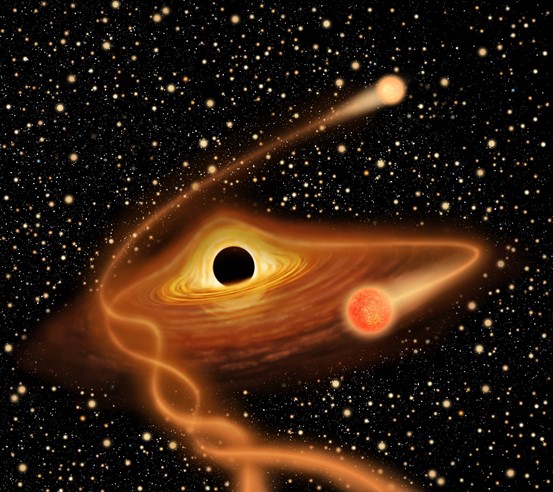
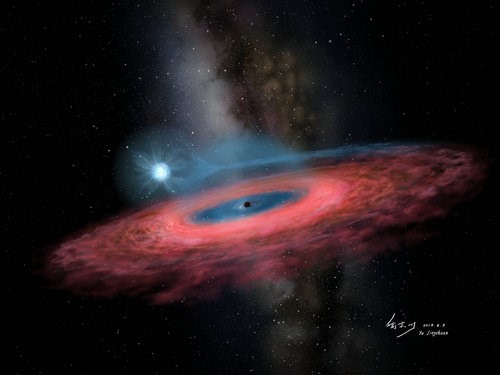
Figure 1, Artistic representation of primordial Milky Way Galaxy
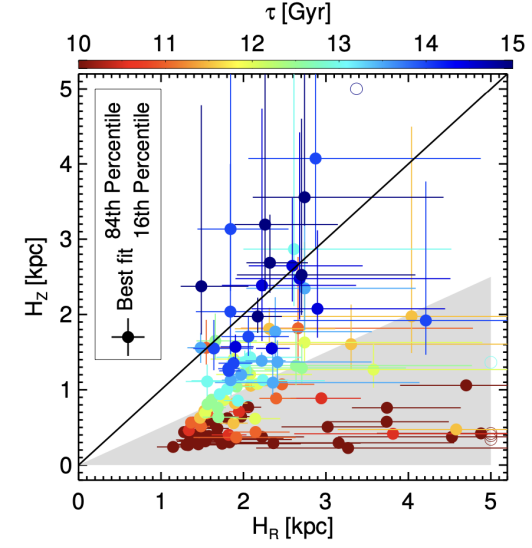
Figure 2, Spatial distribution structural parameters of old Milky Way stars. The horizontal coordinate is scale length, the vertical coordinate is scale height. Stars exhibiting a disk structure (scale height less than scale length) have ages as high as over 13 billion years.
Paper address: https://www.nature.com/articles/s41550-024-02382-w