
Recently, the research team from Shenguang Ⅱ Infrastructure at the Shanghai Institute of Optics and Fine Mechanics of the Chinese Academy of Sciences, has made a significant breakthrough in the time-domain characterization of broadband laser pulses. It proposed a novel bandwidth extension method based on Spectral Correction and Trace Truncation (SCTT), which overcomes the trade-off between measurement bandwidth and sensitivity in broadband ultrashort pulse characterization at the algorithmic level. The findings were published in Optics and Lasers in Engineering.
Broadband ultrashort laser pulses serve as core tools in fields such as optical coherence tomography, intense field physics, and attosecond science. Accurate and complete characterization of their time-domain waveform is a critical prerequisite for their application. In measurement techniques based on second-harmonic generation, nonlinear crystals present an inherent technical contradiction: a thick crystal enhances measurement sensitivity but significantly reduces the phase-matching bandwidth, while an ultra-thin crystal (just a few micrometers thick) can meet the requirements for broadband measurement but at the cost of substantially degraded signal conversion efficiency, measurement sensitivity, and signal-to-noise ratio.
The proposed SCTT method combines the correction effect of spectral filtering functions on the measurement trace with the pulse retrieval capability of multi-grid parallel ptychographic algorithms for incomplete traces. Through a two-step procedure of “spectral correction and trace truncation-reconstruction,” the method achieves accurate retrieval of ultra-broadband pulses.
Using a 100-μm-thick BBO nonlinear crystal which is far exceeding the few-micrometer scale typically used in broadband measurements, the team successfully characterized broadband pulses in the 800 nm wavelength region. The results showed that the pulse waveforms reconstructed by this method are in excellent agreement with standard measurement results obtained using a 5-μm-thick ultra-thin BBO crystal, while the measurement sensitivity is improved by approximately 18 times, and the minimum measurable single-pulse energy is reduced to below 10 pJ.
The SCTT method requires no complex hardware modifications and offers strong adaptability. It can be extended to various pulse measurement techniques based on second-harmonic generation, effectively alleviates spectral overlap between the frequency-doubled and fundamental light, and significantly reduces the requirements for crystal fabrication and optical alignment, providing a new way for the accurate characterization of ultra-broadband laser pulses.
This work was supported by the Strategic Priority Research Program of the Chinese Academy of Sciences, the National Natural Science Foundation of China, and the Shanghai High-level Institutional Construction and Operation Program.
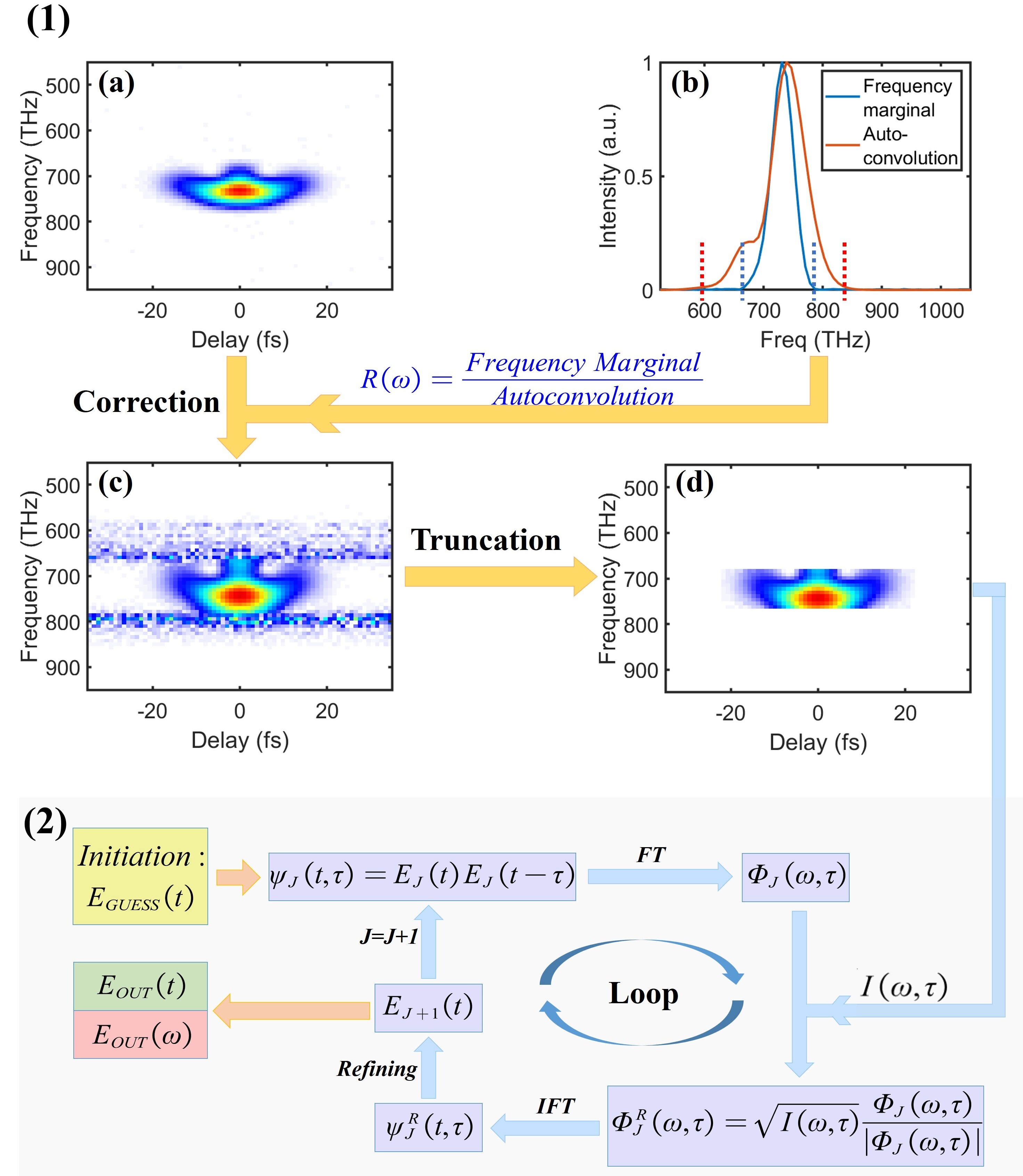
Fig 1. The principle of SCTT
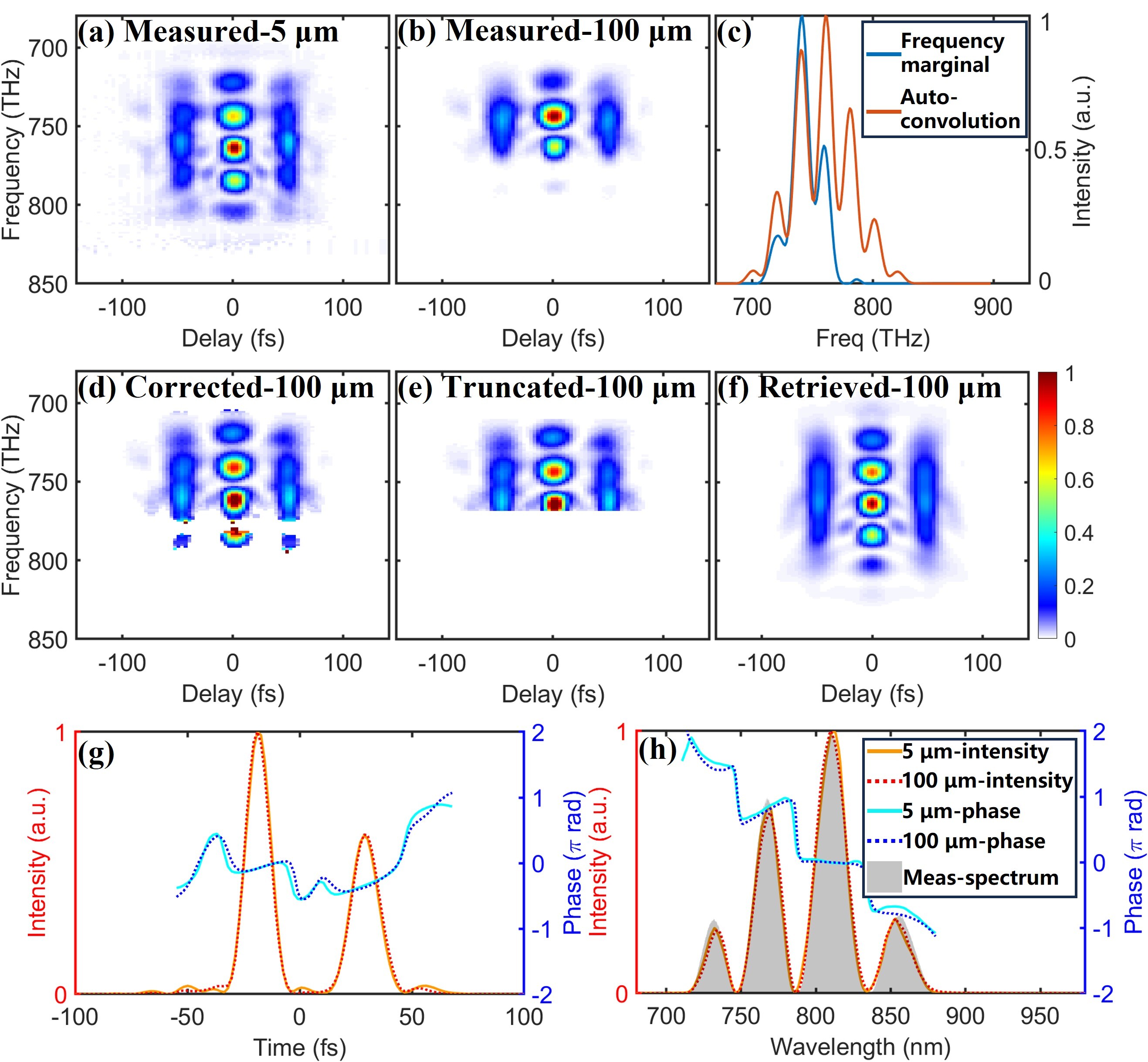
Fig 2. The measurement example of SCTT