Planets sized between Earth and Neptune are ubiquitous around stars in the Milky Way galaxy but absent from our Solar System. These exoplanets, often term as super-earths and mini-neptunes, are among the greatest mysteries in planet formation. A study published in Science and conducted by Ke-Ting Shin, Dong-sheng An, Ji-Wei Xie, Ji-Lin Zhou and Fei Dai first revealed that super-earths and mini-neptunes follow different orbital period—eccentricity relations, indicating that despite with similar sizes, super-earths and mini-neptunes underwent distinct dynamical evolutionary histories.
Absent from the Solar System, but common throughout the Milky Way
The planets in our Solar System are arranged hierarchically: four small rocky planets orbit close to the Sun, while four gas giants travel on the outer orbits. Although Solar System does not possess planets sized between Earth and Neptune, such "mid-sized" planets are common around other stars in the Milky Way galaxy. Since the launch of Kepler space telescope in 2009, astronomers have discovered thousands of exoplanets, most of which are these "mid-sized" planets. Rather than forming a single population, these "mid-sized" planets fall into two categories separated by a "radius valley": rocky super-earths and gaseous mini-neptunes.
A key question remains unanswered for these two planetary populations: beyond their physical differences, are they dynamically distinct as well? For a long time, researchers studying planetary dynamics have treated them as a single population, obscuring important clues.
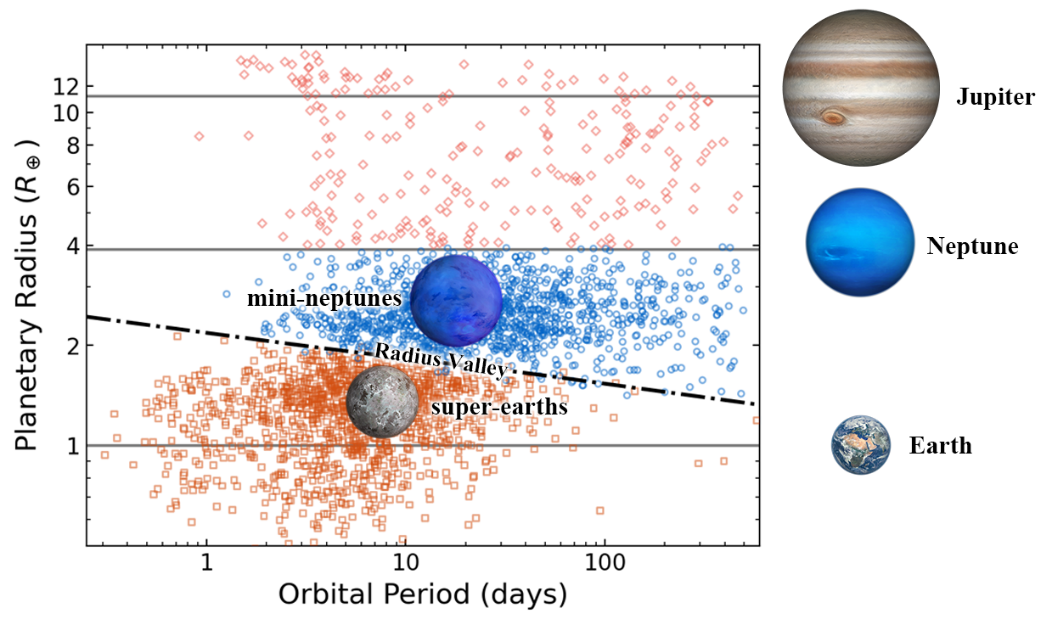
Figure1: The orbital period—radius diagram of Kepler exoplanets. With sizes between Earth and Neptune, super-earths and mini-neptunes separated by a "radius valley" forming the majority of exoplanet demographic. The graphics of the planets are not drawn to scale.
Deriving orbital eccentricity from exoplanets transit observation
The orbital eccentricity of a planet's orbit can quantify its dynamic state and offers records of its dynamical evolutionary histories. However, owing to parameter degeneracy, it is challenging to derive the orbital eccentricity of a transiting exoplanet. Therefore, to advance this research, Ji-Wei Xie’s team utilizes "transit duration ratio" analyses to obtain mean eccentricity of a group of transiting exoplanets. The stellar property data from LAMOST telescope and Gaia satellite play an important role in this process: they provide precise stellar masses, radii, ages, metallicity and other parameters to minimize uncertainties from stellar properties and derive precise planetary parameters.
The important discovery of "POET"
The Planet Orbital Eccentricity Trends (POET) serial aims to reveal the eccentricity pattern in exoplanets demographic. As part of the serial, this work studies the orbital period—eccentricity (P-e) relations for super-earths and mini-neptunes separately. The finding is surprising:
The orbital eccentricities of mini-neptunes increase as orbital periods decrease. This trend is contradicted to the theory of tidal circularization. According to the classic model of equilibrium tide, the tidal forces between a star and a planet will gradually dampen the planet's orbital eccentricity. The shorter the orbital period, the stronger the damping effect, and hence the lower the eccentricity. The discrepancy between the observed P-e anti-correlation and the prediction of tidal theory implies the dynamical evolution of mini-neptunes are dominated by a mechanism called "AMD equipartition." That is, in a well-spaced muti-planet system, the total angular momentum deficit (AMD) of the system is conserved, with any AMD exchange between planets acting toward equipartition. This will result in planets with shorter orbital periods obtaining higher eccentricities.
Super-earths follow a different relation, possibly in the opposite direction: the shorter the orbital periods, the lower the eccentricities. This trend is consistent with the theory of planet-planet scattering and tidal circularization: tidal damping preferentially circularizes short-period orbits, whereas planet-planet scattering increases eccentricities at longer orbital periods.
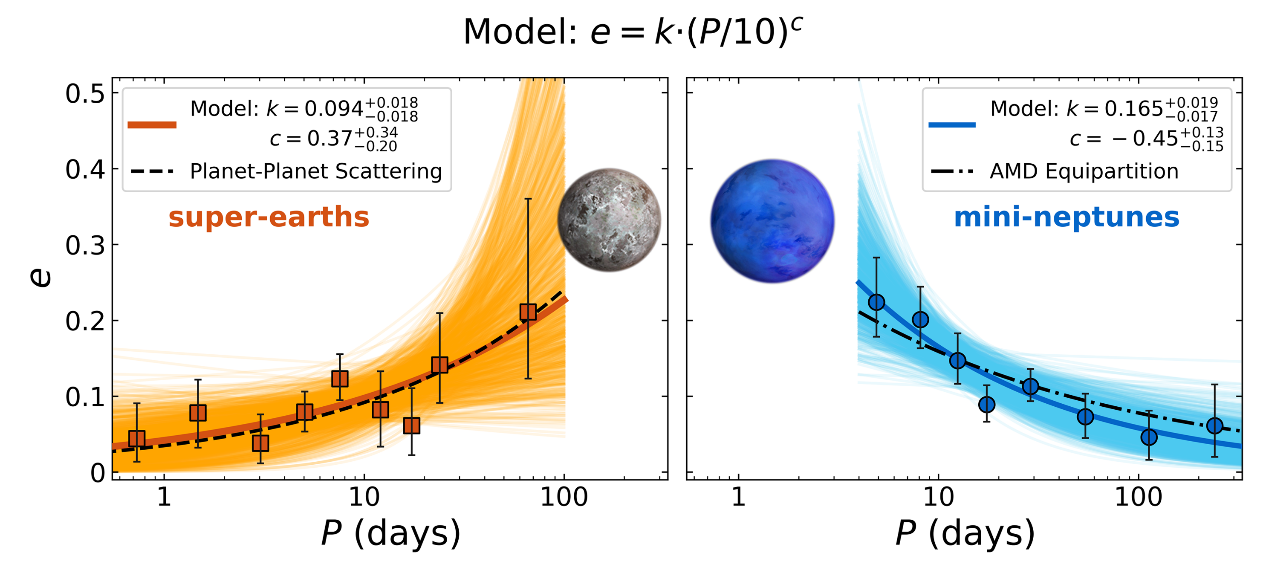
Figure 2: The orbital period—eccentricity relationships of super-earths and mini-neptunes. The graphics of the planets are not drawn to scale.
Two distinct dynamical evolutionary histories: violent vs. quiescent
What does this finding mean? Ji-Wei Xie’s team provides further explanation to the distinct P-e relations of super-earths and mini-neptunes.
"Super-earths are like the survivor among the exoplanets," said Ke-Ting shin, the co-first author of the paper. "They might have experienced violent processes such as planet-planet scattering and giant impacts, which excite longer-period super-earths to higher eccentricities. On the other hand, mini-neptunes are like residents in quiescent systems: they are shaped mainly by the mild secular interactions and have undergone little violent processes. Under the effect of AMD equipartition, the eccentricities of mini-neptunes become anti-correlated with their orbital periods."
"They follow different orbital period—eccentricity relations," said Dong-Sheng An, the co-first author of the paper. "We conducted a series of statistical analyses, confirming the robustness of this result, which proves that super-earths and sub-neptunes underwent distinct dynamical evolutionary histories."
"This finding suggests that a planet’s size not only reflects its composition but also provides clues to its dynamical evolutionary history. Super-earths and mini-neptune look similar, but they are actually distinct. Their distinct dynamical evolutionary histories are crucial to understanding the formation and evolution of planetary systems," as further pointed out by Ji-Wei Xie, the corresponding author of the paper.
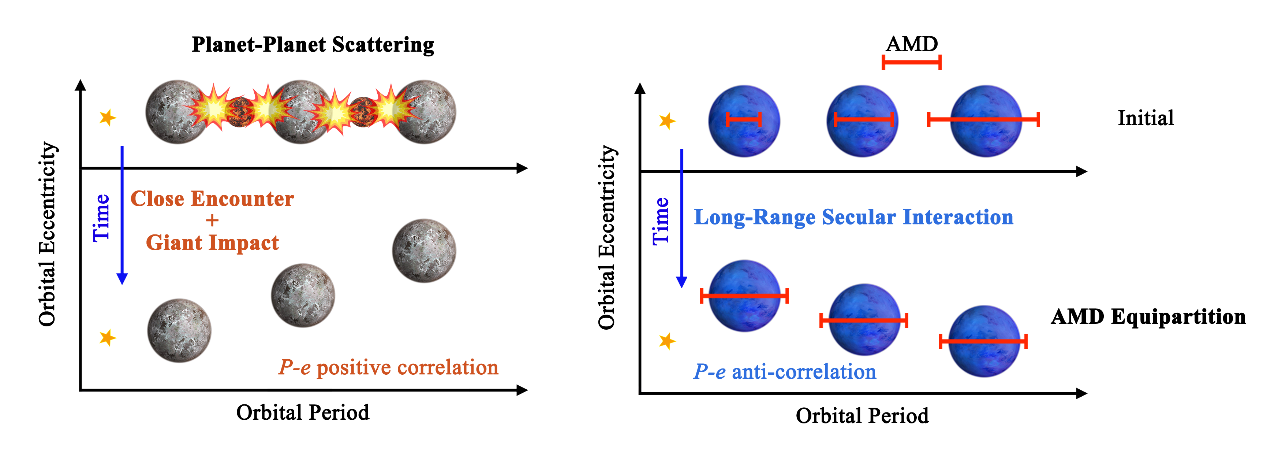
Figure 3: The distinct dynamical evolutionary histories of super-earths and mini-neptunes. The positive orbital period—eccentricity relation of super-earths implies that their dynamical evolutions are governed by planet-planet scattering. That is, close encounters and giant impacts among super-earths excite the eccentricities at longer orbital periods. The orbital period—eccentricity anti-correlation of mini-neptunes implies that their dynamical evolutions are dominated by angular momentum deficit equipartition. Because mini-neptune systems are often well-spaced, the interactions among mini-neptunes are not as violent as those among super-earths. The quiescent secular interaction will transfer angular momentum deficit from the outer planets to the inner ones. This process tends to equalize the angular momentum deficit among all mini-neptunes in the system (AMD equpartition). Because the mini-neptunes in shorter orbital periods gain angular momentum deficit, their eccentricities are pumped up. The graphics of the planets are not drawn to scale.
Implication: from observational patterns to theoretical models
The novelty of this work is that it breaks from the previous statistical approach that treated all "mid-sized" planets as a single population, and for the first time, it reveals that super-earths and mini-neptunes are dynamically distinct populations. This conclusion serves as an important observational constrainton exoplanet formation theories: future models should be able to reproduce these different P-e relations of super-earths and mini-neptunes.
"The 'POET' serial aims to investigate the distribution of orbital eccentricity and its dependence on other parameters," said Ji-Wei Xie. "We will move on to other exoplanet populations and, ultimately, provide the scientific basis to answer whether Earth and the Solar System are special in the universe."