The Ruddlesden-Popper (R-P) series of nickel oxides, denoted as Lan+1NinO3n+1 (where n = 1, 2, 3, ..., ∞), consists of alternating stacks of n layers of LaNiO3 perovskite and LaO rock-salt layers along the c-axis. This arrangement gives rise to compounds with similar structures, such as single-layer La2NiO4 (n = 1), double-layer La3Ni2O7 (n = 2), triple-layer La4Ni3O10 (n = 3), and the infinite-layer LaNiO3 (n = ∞). As n increases, the valence state of Ni gradually rises, accompanied by corresponding changes in the electron filling of the Ni-3d orbitals.
Recently, the team led by Wang Meng at Sun Yat-sen University, in collaboration with others, discovered high-temperature superconductivity with a Tc of approximately 80K in La3Ni2O7 single crystals under a pressure of about 14GPa, attracting widespread attention from peers both domestically and internationally. Subsequent experimental studies have shown that La3Ni2O7 single crystals grown using the optical floating zone method are prone to issues such as chemical inhomogeneity, internal apex oxygen vacancies, and coexistence of single-layer and triple-layer R-P phases due to the narrow range of high oxygen pressures required for their synthesis. These issues result in a strong sample dependence of high-temperature superconductivity in La3Ni2O7 under high pressure, making it exceptionally sensitive to the pressure environment, and, to date, crucial experimental data on bulk superconductivity remain lacking. Currently, there are ongoing controversies surrounding the origin of the high-temperature superconducting phase in La3Ni2O7 and whether bulk superconductivity can be achieved, which have significantly hindered the research progress of nickel-based high-temperature superconductors.
To address these urgent key scientific issues, the team led by Cheng Jinguang at the Institute of Physics, Chinese Academy of Sciences (CAS) / National Research Center for Condensed Matter Physics in Beijing, in collaboration with multiple teams from the CAS Institute of Physics, the University of Tokyo, and Oak Ridge National Laboratory in the United States, has made significant progress in the research of nickel-based high-temperature superconductors. By partially replacing La with Pr, which has a smaller ion radius, they successfully suppressed the coexistence of other R-P phases and internal apex oxygen vacancies in La3Ni2O7, prepared polycrystalline samples of La2PrNi2O7 with significantly improved purity, and provided two crucial experimental evidences of bulk high-temperature superconductivity under high pressure in these samples: zero resistance (Tconset = 82.5K, Tczero = 60K) and complete diamagnetism (with a superconducting shielding volume fraction reaching 97%). Meanwhile, they revealed the adverse effects of microstructural disorder on high-temperature superconductivity in La3Ni2O7 using various experimental techniques.
This work provides key experimental evidence for bulk superconductivity in La2PrNi2O7 and confirms that the high-temperature superconductivity originates from the double-layer perovskite structure (the R-P phase with n = 2), thereby clarifying the ongoing controversies regarding the origin of high-temperature superconductivity and bulk superconductivity in La3Ni2O7. It also points out that the coexistence of different R-P phases is detrimental to bulk superconductivity, while the substitution of La with rare earth elements with smaller ion radii can effectively suppress structural disorder, favoring the achievement of bulk superconductivity. This discovery will guide the further optimal design and synthesis of nickel-based high-temperature superconducting materials, contributing to advancing the research progress of nickel-based high-temperature superconductors.
The relevant findings were published on October 2 in Nature under the title "Bulk high-temperature superconductivity in pressurized tetragonal La2PrNi2O7," available at https://www.nature.com/articles/s41586-024-07996-8. Wang Ningning (postdoctoral researcher at the Institute of Physics), Wang Gang (PhD candidate), Hou Jun (PhD candidate), and Shen Xiaoling (special researcher at the Institute for Solid State Physics, the University of Tokyo, currently a postdoctoral researcher at Shanghai Jiao Tong University) are the co-first authors of the paper. Cheng Jinguang (researcher at the Institute of Physics), Wang Ningning (postdoctoral researcher), Zhou Rui (researcher at the Huairou Research Department of the Institute of Physics), and Yoshiya Uwatoko (professor at the Institute for Solid State Physics, the University of Tokyo) are the co-corresponding authors. The team led by Zhou Rui at the Huairou Research Department of the Institute of Physics, the team led by Yang Huaixin at the Advanced Materials Laboratory, the teams led by Ren Zhi'an and Dong Xiaoli at the Superconducting National Key Laboratory, the team led by Jiang Kun and Hu Jiangping at the Condensed Matter Theory and Material Computation Laboratory, Dr. Jiaqiang Yan and Dr. Stuart Calder from Oak Ridge National Laboratory, and the team led by Kentaro Kitagawa at the Institute for Solid State Physics, the University of Tokyo, among others, participated in this work. The project was supported by the National Key Research and Development Program of China, the National Natural Science Foundation of China, the B-type Pilot Program of the Chinese Academy of Sciences, and the Excellent Youth Member Program of the Chinese Association for the Advancement of Science. This work utilized the six-anvil high-pressure experimental station and the high-field nuclear magnetic resonance experimental station of the Synergetic Extreme Condition User Facility, as well as the 4W2 beamline of Beijing Synchrotron Radiation Facility and the BL15U1 beamline of Shanghai Synchrotron Radiation Facility.
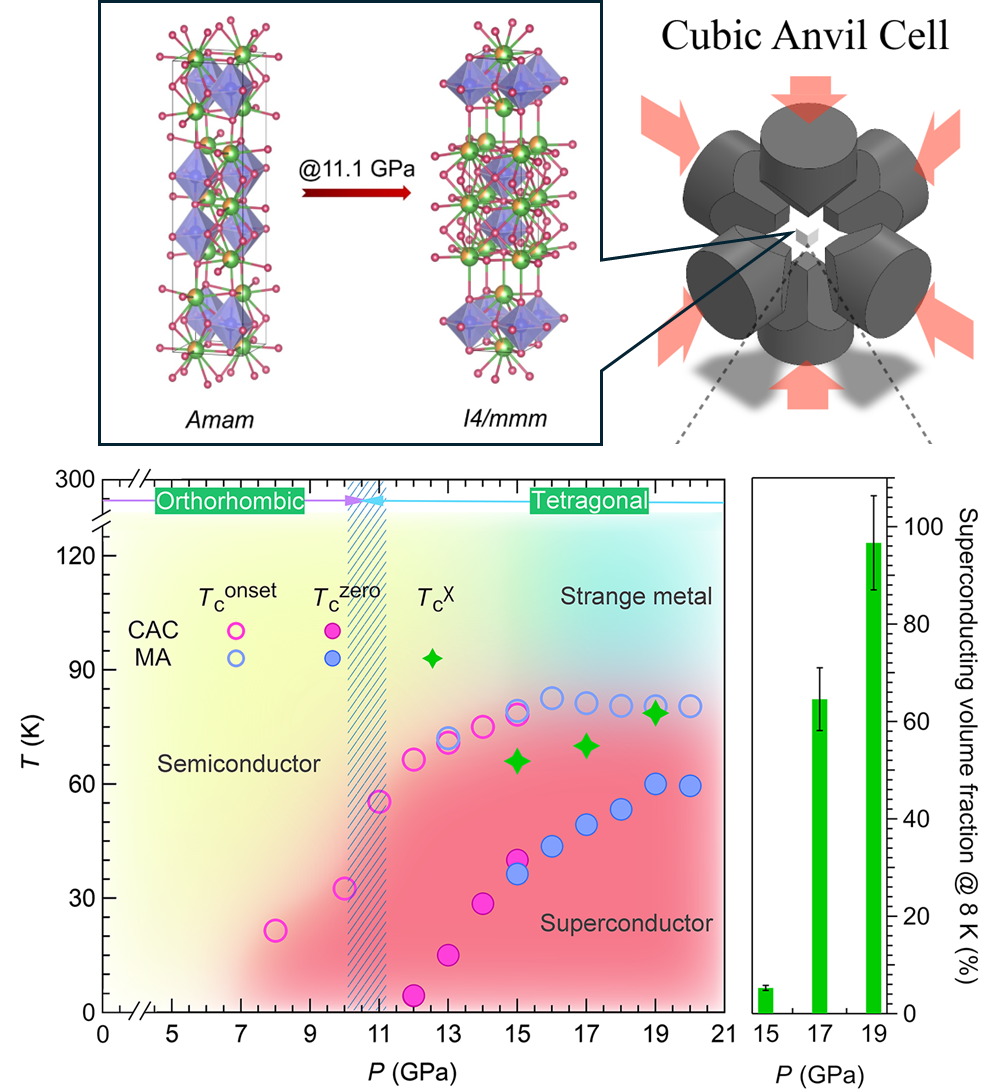
Figure 1. La2PrNi2O7 The high-pressure structural evolution and phase diagram of polycrystalline samples.