Log in Sign up 中文
English
  • Home
  • About
  • Facilities
    • Material
    • Earth System and Environment
    • Engineering Technology
    • Space and Astronomy
    • Particle and Nuclear Physics
    • Energy
    • Biology
  • News
    • News & Updates
    • Research Highlights
  • Notice
  • User Portal
  • Home
  • Facilities
    • Material
    • Earth System and Environment
    • Engineering Technology
    • Space and Astronomy
    • Particle and Nuclear Physics
    • Energy
    • Biology
  • News
    • News & Updates
    • Research Highlights
  • Notice
  • User Portal

Guoshoujing Telescope (LAMOST)

  1. Home>Facilities>Space and Astronomy>Guoshoujing Telescope (LAMOST)>News
  • News
  • Notice
  • Equipment
  • Contact
  • Data Resource
News
  • Chinese Academy of Sciences Leads Discovery of Unpredicted Stellar Black Hole
    Chinese Academy of Sciences Leads Discovery of Unpredicted Stellar Black Hole
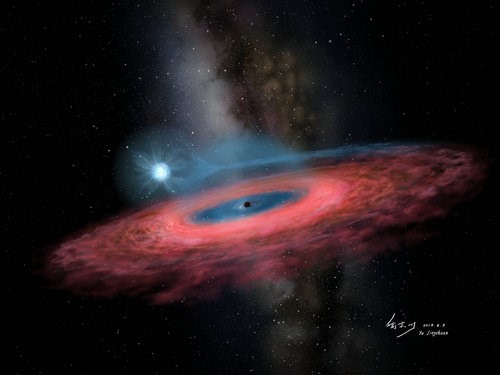
    Our Milky Way Galaxy is estimated to contain 100 million stellar black holes – cosmic bodies formed by the collapse of massive stars and so dense even light can’t escape. Until now, scientists had estimated the mass of an individual stellar black hole in our Galaxy at no more than 20 times that of the Sun. But the discovery of a huge black hole by a Chinese-led team of international scientists has toppled that assumption.
    Our Milky Way Galaxy is estimated to contain 100 million stellar black holes – cosmic bodies formed by the collapse of massive stars and so dense even light can’t escape. Until now, scientists had estimated the mass of an individual stellar black hole in our Galaxy at no more than 20 times that of the Sun. But the discovery of a huge black hole by a Chinese-led team of international scientist...
    Jun 13, 2025
  • Discovery of Pan Gu: Revealing the Origin and Evolution of the Ancient Galactic Disk
    Discovery of Pan Gu: Revealing the Origin and Evolution of the Ancient Galactic Disk
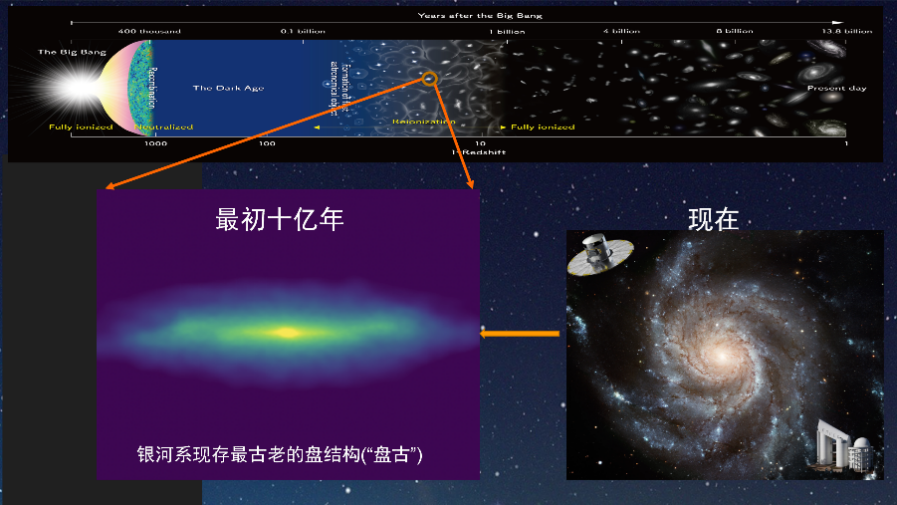
    Based on data from the National Major Scientific Infrastructure LAMOST and the European Space Agency's Gaia satellite, the research team revealed the spatial structural evolution of the ancient Galactic disk, discovering that the oldest surviving structural component of the Galactic disk originated approximately 13.5 billion years ago.
    Beijing time, October 10th, the international scientific journal Nature Astronomy published online an important scientific achievement completed jointly by the National Astronomical Observatories of the Chinese Academy of Sciences (NAOC), the Max Planck Institute for Astronomy in Germany, and other domestic and international institutions. Based on data from the National Major Scientific Infrast...
    Jun 13, 2025
  • Stellar Initial Mass Function Varies with Metallicity and Age of Stars
    Stellar Initial Mass Function Varies with Metallicity and Age of Stars
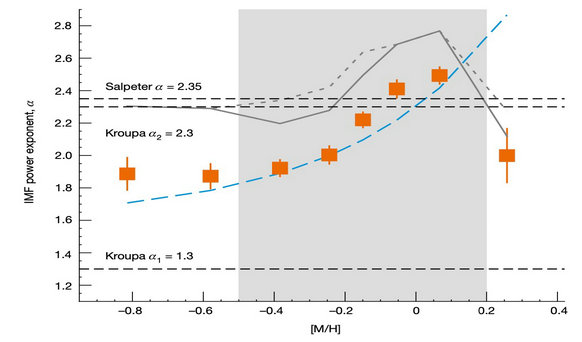
    In the vast and diverse Universe, the initial mass distribution at the birth of a new population of stars determines the fate of galaxies. This relationship is described by the Initial Mass Function (IMF). For more than half a century, astronomers have assumed that the IMF is a universal relationship, i.e., it is uniform throughout the Universe.
    In the vast and diverse Universe, the initial mass distribution at the birth of a new population of stars determines the fate of galaxies. This relationship is described by the Initial Mass Function (IMF). For more than half a century, astronomers have assumed that the IMF is a universal relationship, i.e., it is uniform throughout the Universe.However, in recent years, some indications suggest...
    Jun 13, 2025
  • Researchers Discover Chemical Evidence for Pair-instability Supernova from A Very Massive First Star
    Researchers Discover Chemical Evidence for Pair-instability Supernova from A Very Massive First Star
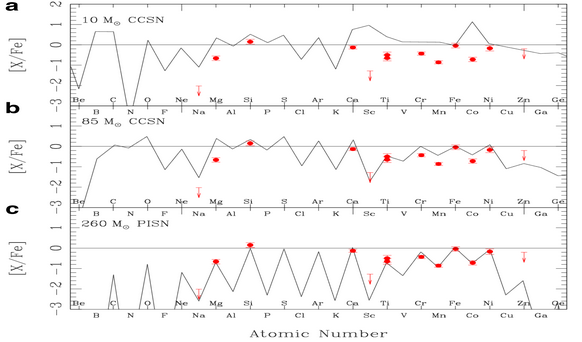
    A new study led by Prof. ZHAO Gang from the NAOC has identified a chemically peculiar star (LAMOST J1010+2358) in the Galactic halo as clear evidence of the existence of PISNe from very massive first stars in the early Universe, based on the LAMOST survey and follow up high resolution spectra observation by Subaru Telescope. It has been confirmed that this star was formed in the gas cloud dominated by the yields of a PISN with 260 solar masses.
    The first stars illuminated the Universe during the Cosmic Dawn and put an end to the cosmic "dark ages" that followed the Big Bang. However, the distribution of their mass is one of the great unsolved mysteries of the cosmos. Numerical simulations of the formation of the first stars estimate that the mass of the first stars reached up to several hundred solar masses. Among them, the first sta...
    Jun 13, 2025
  • "Motion picture" View of the Warped Milky Way Reveals the Shape of its Dark Matter Halo
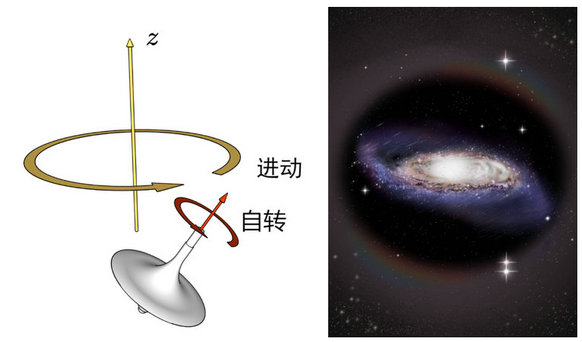
    A Chinese research team led by Dr. HUANG Yang, an associate Professor from the National Astronomical Observatories of the Chinese Academy of Sciences (NAOC) & University of the Chinese Academy of Sciences (UCAS), pioneered the "Motion picture" method for measuring the precession rate of the Milky Way's disk warp.
    A Chinese research team led by Dr. HUANG Yang, an associate Professor from the National Astronomical Observatories of the Chinese Academy of Sciences (NAOC) & University of the Chinese Academy of Sciences (UCAS), pioneered the "Motion picture" method for measuring the precession rate of the Milky Way's disk warp. Using a sample of Cepheid variable stars of different ages, this method allows t...
    Jun 13, 2025
  • Discovery of Long-hidden Small Black Hole in Unusually Evolved Binary System
    Discovery of Long-hidden Small Black Hole in Unusually Evolved Binary System
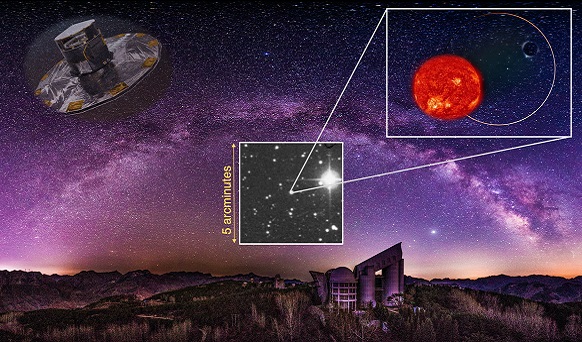
    Chinese researchers have discovered a promising mass-gap black hole using the radial velocity and astrometry methods. The study has been published online in Nature Astronomy on Sept. 10, and was conducted by a team led by Dr. WANG Song, an associate researcher from the National Astronomical Observatories of the Chinese Academy of Sciences (NAOC).
        Chinese researchers have discovered a promising mass-gap black hole using the radial velocity and astrometry methods. The study has been published online in Nature Astronomy on Sept. 10, and was conducted by a team led by Dr. WANG Song, an associate researcher from the National Astronomical Observatories of the Chinese Academy of Sciences (NAOC).    Over the past six decades, scie...
    Jun 13, 2025
PREV12
MORE

Copyright © 2002 - Chinese Academy of Sciences

Address: No.52 Sanlihe Road, Beijing ,100864